Office of Asset and Transportation Management | Updated September 2026
1. Purpose
This guidance serves as a comprehensive reference for federal agencies managing U.S. government license plates and announces the transition to dateless plates as a way to streamline processes and save resources.
2. Background
Requirement: 40 U.S.C.609 requires all federal government vehicles in the U.S. and its territories to be conspicuously identified with the agency’s name and purpose.
UNICOR’s exclusive role: The Office of Government-wide Policy, or OGP, maintains a formal agreement with the Federal Prison Industries — trade name UNICOR — to serve as the government’s sole provider for:
- Motor vehicle license plate manufacturing
- Vehicle and equipment identification plate issuance
- Excess license plate destruction services
Applicability: This agreement applies to all authorized federal agencies, including the District of Columbia.
Limitation: UNICOR provides limited services only to authorized federal entities.
3. Identification, design approval, exemptions
Requirements for vehicle identification and the process for license plate design include:
Statutory requirements
Federal vehicles are legally required to conspicuously display the following:
- “For Official Use Only”
- “U.S. Government”
- The owning agency’s name
License plates as preferred method
U.S. government license plates fulfill this requirement and are the preferred method of identification.
Design approval
All license plate designs must be approved before UNICOR begins production by:
- OGP
- The agency fleet manager
Exemptions
Requirements for vehicle identification and the process for license plate design include:
- Authorization: The head of the agency or their designee has the authority to grant these exemptions.
- Reason for exemption: The exemption is granted when displaying identification would either:
- Endanger the security of the vehicle occupants
- Compromise the agency’s mission
- Certification: To get an exemption, you must provide a written certification, explaining why the identification would cause the issues above.
- Exemption duration: Your agency head (or designee) can grant a limited exemption for a period ranging from one day to a maximum of three years. After that, you must get recertification to continue the exemption.
- Unlimited exemption: Vehicles used primarily for investigative, law enforcement, intelligence, or security duties can have an unlimited exemption. This is specific to when displaying identification would interfere with those duties.
Note: Motor vehicles that have been exempted from the requirement to display official U.S. Government license plates must be registered and inspected in accordance with the laws of the state jurisdiction where the motor vehicle is regularly operated.
4. License plate display
U.S. government license plates are issued in two sizes:
Regular-sized plates for sedans, trucks, and full-sized trailers
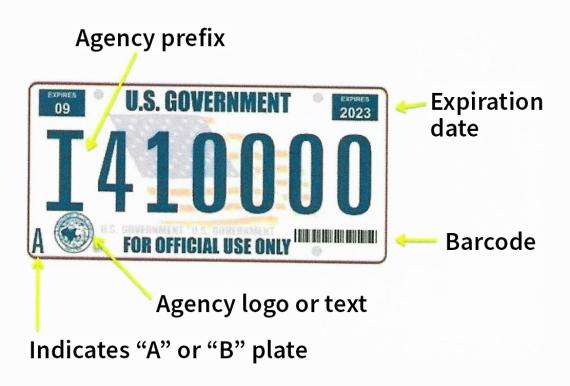
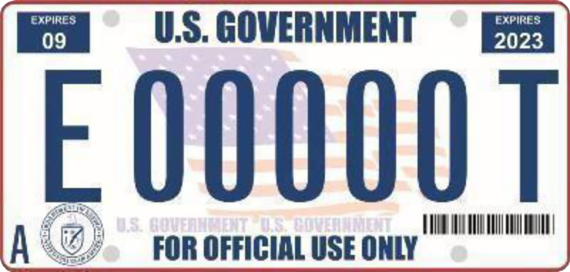
You will order and display a two-plate pair (an A and a B plate) for sedans, trucks and full-sized trailers (for visual reference, see Figure 1 and Figure 2 in the appendix).
Smaller-sized plates for motorcycles or trailers operated on public roads
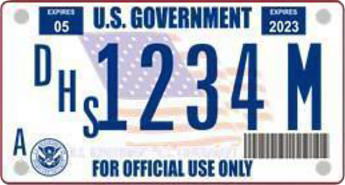
You will order and display a single plate for trailers or motorcycles (the A plate only — refer to Figure 3 in the appendix)
The Federal Acquisition Service tracks the status of each plate from the date of manufacture until you return it for destruction. The plate is active until both plates are returned for destruction.
5. Dateless plates
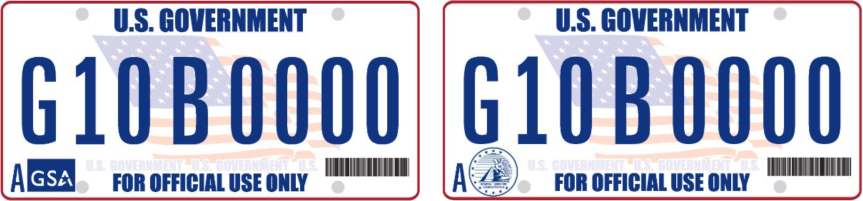
In FY 2025, GSA Fleet® began issuing license plates without the physical month or year expiration dates, or “dateless plates,” in the bar code for leased vehicles with G-plates (for visual reference, see Figure 5 in the appendix).
Agency-owned vehicles
This change does not apply to agency-owned vehicles. They must follow their agency’s internal policies for license plate updates and replacements.
Operating vehicles during transition
Agencies can continue using vehicles with expiring or expired dates visible on their plates during the transition period.
NLETS and GSAFleet.gov updates
FAS will update the National Law Enforcement Telecommunication System, also known as NLETS, and GSAFleet.gov registrations to reflect that GSA Fleet license plates no longer expire.
6. Non-expiring NLETS messaging
Advancements in law enforcement sharing networks, including real-time plate status available through NLETS, makes expiration dates on federal license plates unnecessary. However, in case local law enforcement is unaware, agencies should ensure that the following message is printed and placed in the glove compartment of the vehicle to provide should a traffic stop occur.
U.S. GOVERNMENT VEHICLE INFORMATION
This federal vehicle is registered in the Federal Motor Vehicle Registration System (FMVRS) which is part of GSAFleet.gov.
The information below is from the FMVRS vehicle record. Law enforcement agencies can validate this information through the National Law Enforcement Telecommunications System (NLETS). To perform a registration query (RQ) on a federal government vehicle or license plate, the state designation code is “GS” followed by the VIN or license plate number.
Note: Federal plates no longer require an expiration date. Expiration dates are being phased out by some federal agencies. Other federal agencies may choose to maintain expiration dates. License plates with expired, blank, or 00/00 expiration dates are all valid.
The U.S. vehicle identification card is not an actual registration card. This card states that the federal license plates and motor vehicle identification number are registered in GSAFleet.gov and provides vehicle, license plate, and insurance information.
The U.S. vehicle identification card may be downloaded at GSAFleet.gov — to download the VIN card, a new style license plate with a valid expiration date must be properly assigned to a vehicle and registered in GSAFleet.gov.
7. Beyond expiration dates
GSA Fleet vehicles
Coordinate with your GSA Fleet service representative, or FSR, for GSA Fleet vehicles that you need to:
- Continue operating vehicles with nearing expiration or expired dates visible while you transition to new dates.
- Phase out expiring license plates through normal attrition, for example, when a vehicle is retired or the lease ends.
Agency-owned fleet vehicles
Coordinate with your agency fleet manager and UNICOR for vehicles your agency owns in order to:
- Order dateless plates immediately.
- Order dateless plates when current tags expire naturally.
- Continue to use expiration dates on agency tags.
- Register agency-owned vehicles with non-expiring (dateless) plates in GSAFleet.gov.
Currently, the only agencies who are authorized to order dateless plates are GSA Fleet, U.S. Coast Guard, Department of Transportation, Defense Logistics Agency, and USDA.
8. Dateless plates contacts
For GSA Fleet leased vehicles, where the license plate starts with “G” — contact your GSA Fleet service representative.
For Agency owned vehicles — contact your agency fleet manager or UNICOR license plate representative at cusgdlp@usdoj.gov.
9. Manufacturing
UNICOR manufactures, sells and provides destruction services only to authorized federal entities through its online license plate store. UNICOR also offers design services, automated online ordering, and populates order and destruction information via GSAFleet.gov.
10. Purchasing
Agency prefix codes
UNICOR must ensure federal entities only order license plates using their assigned agency prefix code.
- Neither federal entities nor UNICOR can create new agency prefix codes without authorization from OGP
Memorandum of understanding
Each agency must have an MOU with UNICOR outlining:
- Who is authorized to purchase license plates
- Payment methods
- Shipping procedures
- Whether the agency or UNICOR is responsible for numbering the plates
Numbering responsibility
If an agency chooses to number their own plates, they are responsible for preventing duplicate numbers.
Account setup
To set up an account and access the online license plate store, contact UNICOR at cusgdlp@usdoj.gov.
UNICOR shall provide a notification of receipt for each order to the ordering agency that includes at a minimum the following:
- Date of order
- Ordering official and office
- Description of order
- Estimated delivery date
- Delivery address
- Method of delivery
- Cost
Standard processing and shipping
UNICOR will process agency orders, manufacture license plates, and ship completed orders within three business days of order placement.
Price change notification
UNICOR will announce price changes to customers at least 60 days before the new prices take effect.
Single plates
Pricing for single plates for motorcycles and trailers will be quoted separately between the federal agencies and UNICOR.
Production delays
- If production delays exceed three business days but are no more than three weeks, UNICOR will notify OGP and the customer.
- The notification will include the reason for the delay, the estimated shipment date for orders being processed, and the expected date for return to normal shipment intervals.
- Potential compensation for late delivery will be determined on a case-by-case basis.
Expedited processing and shipping
UNICOR offers expedited processing and shipping for an additional cost. Expedited orders are manufactured and shipped within five (5) business days.
11. Registration of license plates
The FMVRS, which is accessible via GSAFleet.gov, is the home for federal vehicle registrations and license plate inventory management and destruction.
Ordering platform
U.S. government license plates must be ordered through UNICOR.
Access point
FMVRS is accessible via GSAFleet.gov.
Agency responsibility
Agencies are responsible for ensuring the accuracy of vehicle and license plate data in GSAFleet.gov throughout the vehicle and plate lifecycle.
Key FMVRS functions
FMVRS is used to:
- Reconcile agency UNICOR license plate orders
- Register newly acquired vehicles
- Initiate the process of submitting plates to UNICOR for destruction
Complete vehicle registration
A complete vehicle registration in FMVRS requires:
- Two complete, unique points of contact
- Vehicle year, make, and model
- Color
- FAST (Federal Automotive Statistical Tool) reporting designation
Incomplete registration
If any of these key identifiers are missing, the vehicle is listed as “Incomplete.”
12. License plate order status
Updating the status of GSAFleet.gov license plate records is the responsibility of the agency. We will only update records for you in extraordinary circumstances. If you believe you have an extraordinary circumstance, your request must come from your agency/bureau fleet manager.
13. Returning license plates
If you have U.S. government license plates that are expired, removed, replaced, damaged or unneeded, your agency must return them to UNICOR for destruction. There is no charge for the return shipment of excess license plates.
No reuse
U.S. government license plates (of all types and sizes) that have been “attached” to a vehicle cannot be reused.
Destruction upon disposal
When a vehicle is disposed of, the attached license plates must be returned to UNICOR for destruction.
Other reasons for return
U.S.Government license plates that are expired, removed, replaced, damaged, or unneeded must be returned to UNICOR for destruction.
14. Lost or stolen license plates
Immediate actions
- As soon as you notice a license plate is missing, you must report it to your local security office at once.
- Report missing U.S. government license plates — and update their status to “missing” in GSAFleet.gov — immediately. Do not delay while searching for the plate.
Reporting procedure for U.S. government license plates
- Report to your local security office (or equivalent).
- Report to your local police department.
- Report to GSAFleet.gov when a GSA Fleet-leased motor vehicle is involved.
- Update the status of the license plates in FMVRS.
Reporting procedure for the District of Columbia or state license plates
- Report to your local security office or equivalent.
- Report to either District of Columbia Department of Transportation or to the state’s Department of Motor Vehicles, as appropriate.
Additional information
- Taking immediate action alerts law enforcement through NLETS. Therefore, if the plate is spotted by law enforcement, agents will receive a message that the plate is missing and to approach with caution.
- In addition to the above actions, we recommend that agencies report missing plates to the Federal Protective Service via their national toll-free number, 1-877-437-7411.
- U.S. government plates will not have the same numbers as the originals — this is to prevent potential misuse.
- If the missing plate is later found and reattached to the vehicle, you can reverse the status as “attached” in GSAFleet.gov.
- There is no penalty for listing a plate as missing.
- Lost or missing license plates cannot be re-ordered.
15. Release of information to outside sources
The following procedures emphasize the importance of protecting GSAFleet.gov license plate and registration data and restricting its release to NLETS only. Agencies can access their own data within the system but should not share it externally to maintain security and protect law enforcement operations.
NLETS is the sole recipient: GSAFleet.gov registration information is only released to NLETS.
Safeguards in NLETS: GSA Fleet has built in several precautions to its responses to NLETS inquiries to protect federal law enforcement agents and their mission.
No external sharing: These safeguards are compromised if you provide GSAFleet.gov data outside of the NLETS system. Therefore, agencies and users should not share GSAFleet.gov data outside of NLETS.
Agency access: Agencies and their authorized users have full access to their own data within the GSAFleet.gov system and can examine information as needed within the system itself.
16. Vehicle transfers
Once “attached” to a vehicle, the license plate stays with that vehicle until the vehicle is disposed of by the owning agency. However, sometimes, agencies elect to transfer vehicles to new agencies or transfer vehicles between activities and/or locations within the same agency.
Vehicle transfers to a new agency
The GSAFleet.gov user guide explains how to transfer a vehicle from one agency to another within the GSAFleet.gov entity. The original license plates attached to the vehicle that is being transferred to a new agency must be dissociated from that vehicle within GSAFleet.gov, have their status updated within the GSAFleet.gov as “Pending Destruction.”
The actual license plates should be removed from the vehicle and returned to UNICOR following the SOP (found on the GSAFleet.gov main page). The new agency will be responsible for purchasing license plates for the transferred vehicle and updating GSAFleet.gov to confirm the new agency, new POC, and the new license plate number.
Vehicle transfers within the same agency
When a vehicle is transferred within the same agency (from one bureau to another, or from one location to another), internal agency policy should determine if the tags remain with the vehicle or should be replaced.
17. Off-road identification plates
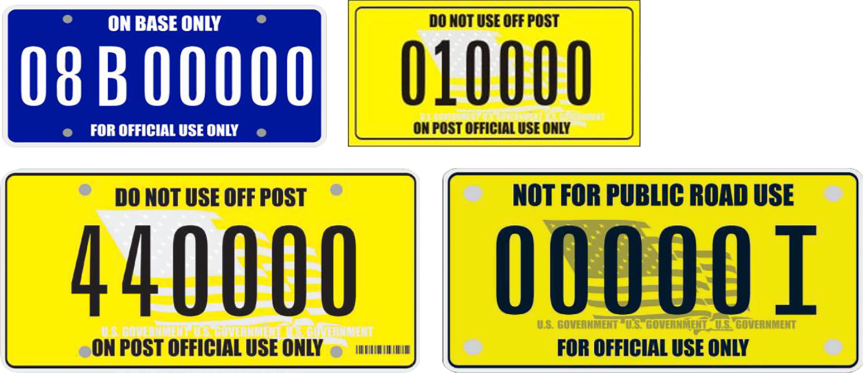
Off-road identification plates are only for equipment that never operates on public roads. If the equipment ever operates on a public road, it must have official U.S. government license plates (see Figure 4 in the appendix).
Purpose
- Off-road identification plates are used for numbering and identifying equipment that is never operated on public roads.
- U.S. government license plates are required for vehicles operated on public roads.
Official status
- Off-road identification plates are not official license plates.
- U.S. government license plates are official license plates.
Design
- Off-road identification plates are designed to be bright and obvious, so they are easily distinguishable from official license plates.
- U.S. government license plates follow specific design standards.
Registration
- Off-road identification plates are not required to be registered in GSAFleet.gov.
- U.S. government license plates must be registered in GSAFleet.gov.
Use on public roads
- Off-road identification plates should never be used on public roads.
- U.S. government license plates are required for vehicles operating on public roads.
Ordering
- Off-road identification plates are approved by OGP and manufactured by UNICOR.
- U.S. government license plates are ordered through UNICOR.
Numbering
- Off-road identification plates should not begin with the agency prefix or any letter. The agency prefix letter should ideally identify the end (right side) of the plate number, but this is not a requirement.
- U.S. government license plates follow specific numbering conventions.
18. State and foreign plates
State license plates
- Are registered by the respective state’s Department of Motor Vehicles.
- Must follow state procedures.
Locally issued plates in foreign countries
- Must follow the laws and regulations of the country where they are issued.
Off-road vehicle identification plates
- Are not official license plates, as previously established.
GSAFleet.gov registration exclusion
- Off-road vehicle identification plates, state license plates, and locally issued, non-U.S. government plates in foreign countries are not required to be registered in GSAFleet.gov.
19. Sample or customized U.S. government license plates
U.S. government sample plates are invalid: U.S. government sample license plates are no longer authorized, produced, or valid.
Security risk: Even the remote possibility of a sample plate being illegally used and mistaken for a valid plate is enough to prohibit their use.
Access control: Display of a federal license plate is a key to gaining access to federal facilities or conducting certain activities.
Implications
- Heightened security awareness: This emphasizes the importance of strict control over official license plates and the need to prevent any unauthorized use or display of look-alike plates.
- This notice reflects a heightened security posture and eliminates the use of U.S. government sample license plates due to the risk of misuse and potential security breaches.
20. License plate codes
U.S. government license plates for agency-owned vehicles begin with the agency prefix and may contain an agency name or logo in the lower left corner of the license plate. GSA Fleet-leased vehicles use the prefix “G.” For more information see federal government license plate prefix codes.
If you find any errors in the list of license plate codes or if you would like to request a copy of the Desk Reference Guide for U.S. government License Plates and the GSA-UNICOR Memorandum of Understanding, or MOU, please send your requests to vehicle.policy@gsa.gov.
21. Effective date
This guidance is effective immediately and remains in effect until rescinded or superseded.
22. Questions?
Send any questions or comments to vehicle.policy@gsa.gov.
To order license plates, reach out to cusgdlp@usdoj.gov or GSAFleet.gov.
Appendix A: Figures
Below are visual representations of types of license plates referenced in this guide.
Since FY 2025, GSA Fleet-leased vehicle license plates have been produced without expiration dates. GSA Fleet made this change only for the G-plated vehicles for our leasing customers. Agency-owned vehicles must follow the respective agency’s processes for updating license plate.
You may continue to operate your vehicles with nearing expiration and expired dates visible during this transition.
As of August 6, 2024, both NLETS and GSAFleet.gov registrations have been updated to indicate that license plates no longer expire.
If you have a compelling need for a new license plate, please contact your Fleet Service Representative.
Figure 1: Example of a regular-size license plate for sedans and trucks
Figure 2: Example of a regular-sized trailer license plate
Regular-sized trailer license plates end with the letter “T.”
Figure 3: Example of a motorcycle-sized license plate
Motorcycle-size license plates end with the letter “M.”
Figure 4: Example of off-road plates and equipment identification plates
Figure 5: Examples showing dateless plates
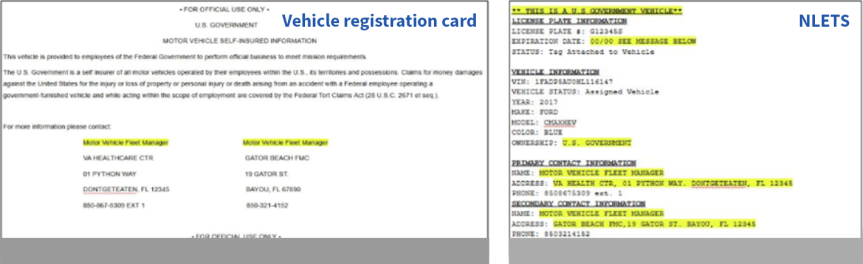
Figure 6: Vehicle and license plate registration
In September 2025, GSA Fleet updated the following vehicle and license plate information printed on the vehicle registration card from GSAFleet.gov fed into NLETS. Names of individuals will be replaced with “Motor Vehicle Fleet Manager.”
NLETS messaging will:
- Highlight that it’s a U.S. government vehicle at the top of the card
- Display a 00/00 expiration date (for a non-expiring license plate) at the top of the card with a note to “read the message below for more information”
- Display addresses Lines 1-3 instead of just the address Line 1


 U.S. General Services Administration