An official website of the United States government

Here’s how you know

Official websites use .gov
A .gov website belongs to an official government organization in the United States.

Secure .gov websites use HTTPS
A lock ( ) or https:// means you’ve safely connected to the .gov website. Share sensitive information only on official, secure websites.

GSA Logo U.S. General Services Administration
    • Explore buy through us
    • Category management
    • Government property for sale or lease
      Toggle submenu
      • Personal property (tangible goods)
      • Real property (real estate and buildings) for public use
      • Real property sales
      • Vehicle sales
    • Products and services
      Toggle submenu
      • Human capital
      • Industrial products and services
      • Office management
      • Professional services
      • Security and protection
      • Transportation and logistics services
    • Purchasing programs
      Toggle submenu
      • Assisted acquisition
      • Commercial platforms
      • Federal strategic sourcing initiative
      • Fleet management
      • HCaTS and HCaTS SB
      • OASIS and OASIS SB
      • Requisition programs
      • State and local programs
      • Emergency acquisition basic ordering agreements
    • Shared services
      Toggle submenu
      • Payroll services
      • Support services for CABs

    Featured Topics

    • Multiple Award Schedule Governmentwide contracts for products and services at volume discount pricing.
    • Auctions Federal assets available via auction to the general public.
    • Explore sell to government
    • Step 1: Learn about government contracting
      Toggle submenu
      • Ways you can sell to government
      • How to access contract opportunities
      • Conduct market research
    • Step 2: Compete for a contract
      Toggle submenu
      • Register your business
      • Certify as a small business
      • Become a schedule holder
      • Market your business
      • Research active solicitations
      • Respond to a solicitation
      • What to expect during the award process
    • Step 3: Manage your contract
      Toggle submenu
      • Comply with contractual requirements
      • Handle contract modifications
      • Monitor past performance evaluations

    Featured Topics

    • Contract opportunities on SAM.gov Search current federal contract opportunities and procurement notices.
    • Forecast of contracting opportunities Anticipated contracts offered by GSA.
    • Vendor support center Research the federal market, report sales, and upload contract information.
    • Explore real estate
    • Design and construction
      Toggle submenu
      • 3D-4D building information modeling
      • Computer-aided design standards
      • Engineering
      • Project management information system
      • Prospectus thresholds
    • Facilities management
      Toggle submenu
      • Security
      • Tenant services
      • Water quality management
    • Our properties
      Toggle submenu
      • Owned and leased properties
      • Renting property
    • Real estate services
      Toggle submenu
      • Leasing resources
      • Real property disposal
      • Reimbursable services (RWA)
      • For businesses seeking opportunities
      • For workers in federal buildings
      • Voice of the customer
    • Workplace optimization
      Toggle submenu
      • Commercial coworking
      • Space Match
    • Explore historic buildings

    Featured Topics - Real Estate

    • Historic preservation tools and resources Procedures for maintaining and repairing historic buildings.
    • Real property disposal Dispose or acquire excess federal real property including buildings or land.
    • Explore policy and regulations
    • Acquisition policy
    • Aviation management policy
    • Federal Advisory Committee Act management
    • Information technology policy
    • Real property management policy
    • Travel management policy
    • Regulations
      Toggle submenu
      • Federal acquisition regulations
      • Federal management regulations
      • Federal travel regulations

    Featured Topics

    • Forms Search for a government form.
    • Per diem FAQs Frequently asked questions about per diem rates and related topics.
    • Explore small business
    • Small business goals
    • Register your business
      Toggle submenu
      • Explore business models
      • Research the federal market
      • Subcontracting and other partnerships
    • Forecast of contracting opportunities
    • Small business resources
      Toggle submenu
      • Small business contacts
      • Videos

    Featured Topics

    • Forecast tool Information on planned federal contracting opportunities.
    • Socio economic categories Check your eligibility for small-business set-asides.
    • Training resources Suggested training for doing business with us.
    • Explore travel
    • Plan a trip
      Toggle submenu
      • Per diem rates
      • Transportation (airfare rates, POV rates, etc.)
      • Lodging
      • Travel charge card
    • Travel and lodging services
      Toggle submenu
      • E-gov travel service (ETS)
      • Rideshare
      • Travel category schedule
    • Federal travel regulation

    Featured Topics

    • Per diem rates look-up Allowances for lodging, meal and incidental costs while on official government travel.
    • Mileage reimbursement rates Reimbursement rates for the use of your own vehicle while on official government travel.
    • Explore technology
    • Purchasing programs
      Toggle submenu
      • Cloud computing services
      • Cybersecurity products and services
      • Governmentwide acquisition contracts
      • MAS information technology
      • USAccess
    • Government initiatives
      Toggle submenu
      • Artificial Intelligence
      • Cybersecurity
      • Emerging citizen technology
      • FedRAMP
      • Federal identity, credentials, and access management
      • Robotic process automation community
      • Technology modernization fund
    • Training

    Featured Topics

    • Challenge.gov Government sponsored challenges and prize competitions.
    • Data.gov Access U.S. government data.
    • Multiple award schedule IT category Information technology products, services and solutions.
    • Explore about us
    • Background and history
      Toggle submenu
      • Overview
      • Mission and strategic goals
      • Role in presidential transitions
    • Careers
      Toggle submenu
      • Get an internship
      • Launch your career
      • Elevate your professional career
      • Discover special hiring paths
      • Resources and related links
    • Events and training
      Toggle submenu
      • Events, training, and request a speaker
      • Our training programs
    • Newsroom
      Toggle submenu
      • Agency blog
      • Congressional testimony
      • GSA does that podcast
      • News releases
      • Speeches
      • Videos
    • Organization
      Toggle submenu
      • Leadership directory
      • Federal Acquisition Service
      • Public Buildings Service
      • Staff offices
    • Contact us

    Featured Topics

    • Blog Read the latest GSA news, updates and analysis.
    • Careers Learn what we have to offer.
  • Per diem lookup
Buy through us
Explore buy through us
Category management
Government property for sale or lease
Personal property (tangible goods)
Real property (real estate and buildings) for public use
Real property sales
Vehicle sales
Products and services
Human capital
Industrial products and services
Office management
Professional services
Security and protection
Transportation and logistics services
Purchasing programs
Assisted acquisition
Commercial platforms
Federal strategic sourcing initiative
Fleet management
HCaTS and HCaTS SB
OASIS and OASIS SB
Requisition programs
State and local programs
Emergency acquisition basic ordering agreements
Shared services
Payroll services
Support services for CABs
Sell to government
Explore sell to government
Step 1: Learn about government contracting
Ways you can sell to government
How to access contract opportunities
Conduct market research
Step 2: Compete for a contract
Register your business
Certify as a small business
Become a schedule holder
Market your business
Research active solicitations
Respond to a solicitation
What to expect during the award process
Step 3: Manage your contract
Comply with contractual requirements
Handle contract modifications
Monitor past performance evaluations
Real estate
Explore real estate
Design and construction
3D-4D building information modeling
Computer-aided design standards
Engineering
Project management information system
Prospectus thresholds
Facilities management
Security
Tenant services
Water quality management
Our properties
Owned and leased properties
Renting property
Real estate services
Leasing resources
Real property disposal
Reimbursable services (RWA)
For businesses seeking opportunities
For workers in federal buildings
Voice of the customer
Workplace optimization
Commercial coworking
Space Match
Explore historic buildings
Policy and regulations
Explore policy and regulations
Acquisition policy
Aviation management policy
Federal Advisory Committee Act management
Information technology policy
Real property management policy
Travel management policy
Regulations
Federal acquisition regulations
Federal management regulations
Federal travel regulations
Small business
Explore small business
Small business goals
Register your business
Explore business models
Research the federal market
Subcontracting and other partnerships
Forecast of contracting opportunities
Small business resources
Small business contacts
Videos
Travel
Explore travel
Plan a trip
Per diem rates
Transportation (airfare rates, POV rates, etc.)
Lodging
Travel charge card
Travel and lodging services
E-gov travel service (ETS)
Rideshare
Travel category schedule
Federal travel regulation
Technology
Explore technology
Purchasing programs
Cloud computing services
Cybersecurity products and services
Governmentwide acquisition contracts
MAS information technology
USAccess
Government initiatives
Artificial Intelligence
Cybersecurity
Emerging citizen technology
FedRAMP
Federal identity, credentials, and access management
Robotic process automation community
Technology modernization fund
Training
About us
Explore about us
Background and history
Overview
Mission and strategic goals
Role in presidential transitions
Careers
Get an internship
Launch your career
Elevate your professional career
Discover special hiring paths
Resources and related links
Events and training
Events, training, and request a speaker
Our training programs
Newsroom
Agency blog
Congressional testimony
GSA does that podcast
News releases
Speeches
Videos
Organization
Leadership directory
Federal Acquisition Service
Public Buildings Service
Staff offices
Contact us
  1. Home
  2. Real estate
  3. Historic preservation
  4. Explore historic buildings
  5. Find a Building
  6. U.S. Courthouse, Des Moines IA

U.S. Courthouse, Des Moines IA

Building History

Des Moines Federal Building

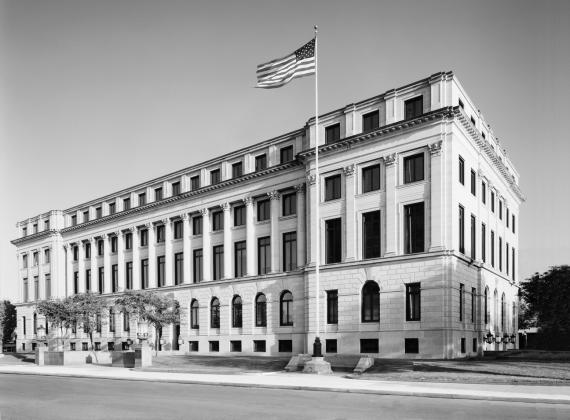
One of a group of stately public buildings along Des Moines’ riverfront, the U.S. Courthouse at 123 East Walnut Street is a significant monument in the Civic Center Complex. It illustrates principles of Beaux Arts architectural design and urban planning.

In 1902, as Des Moines initiated plans to establish a civic center based on City Beautiful ideals, the riverfront was recommended as the site of a new federal Courthouse. Other sites were considered in 1913 when funds were allocated, but the riverfront was still preferred as “one of the most desirable sites offered.” Land was bought in 1918, but concerns over the need for additional space delayed the project until adjacent sites were purchased in 1926. The new U.S. Courthouse was finally constructed in 1927-1928 under Acting Supervising Architect of the Treasury James A. Wetmore.

When the building opened in 1929, it housed the Courts and federal departmental offices including War, Justice, Navy, Interior, Agriculture, Commerce, Treasury, and the Post Office. The U.S. Courthouse was the site of a landmark legal decision in 1979 when Judge William C. Stuart held that it is the federal government’s right to legislate travel by “long” trucks on interstate roads maintained by federal funding. The Supreme Court subsequently upheld this decision.

The U.S. Courthouse is one of seven monumental public buildings constructed along the Des Moines River. The other Civic Center buildings include: the Des Moines Public Library (1900-1903); the Post Office (1909-1910); the Municipal Building (1909-1910); the Coliseum (1909-1910; burned 1949), the Municipal Court and Public Safety Building (1918-1920), and the Armory and World War Memorial Building (1934-1935). These buildings are distinguished by their location and harmonious design. Five of the extant buildings are Neoclassical, while the Armory is Art Moderne. All reflect the City Beautiful Movement precepts by promoting civic patriotism, and enhancing urban economics and beauty.

In 1988 the riverfront area, including the U.S. Courthouse, was designated as the Civic Center Historic District and listed in the National Register of Historic Places. In 1995 a build-to-suit leased annex with additional court space was constructed to the building’s south.

Architecture

As part of a dramatic grouping of monumental civic buildings along the banks of the Des Moines River, the U.S. Courthouse holds an important role in the urban landscape of Des Moines. Sited on the river, the building occupies an entire city block and is accessed from a major thoroughfare through the central business district.

The five-story, E-shaped building is a steel-frame structure clad with Indiana limestone. Its four variations of stone finishes emphasize the aesthetic ideals of the Neoclassical style. The raised basement is clad in smooth ashlar limestone with flat-arched window openings. The piano nobile is finished with rusticated limestone pierced by semi-circular arched openings ornamented with keystones. Two-story Corinthian columns and pilasters veneered in smooth limestone mark the third and fourth stories. The recessed attic story is articulated with paneled pilasters and a banded cornice. A striking feature is the pronounced entablature at the top of the third story, featuring sloping modillions, a modestly detailed stone cornice, and molded frieze.

The primary (north) facade is the most elaborate elevation. It is nineteen bays wide with slightly projecting pavilions. The thirteen center-most bays are enhanced by fourteen massive engaged columns with Corinthian capitals. Fenestration is formally organized and includes arched windows on the first story, large rectangular windows on the second story, and square windows on the third story and attic level. The central (main) entrance is articulated with three, two-story semi-circular arches adorned by rusticated voussoirs and large scrolled keystones. Secondary entries are set within three arched openings at the center of the more austere east and west elevations. The east and west facades are seven bays wide and presented in a three-part composition that echoes the primary facade.

The interior of the Des Moines courthouse reflects the restrained quality associated with late Neoclassical design. The ceremonial entrance hall contains the original gold, black, and white speckled terrazzo flooring framed by a base of Red Verona marble. The grand stair leading to the entrance hall is composed of Napoleon gray marble treads and buff-colored marble risers. The elaborate, classically styled, cast-iron balustrade is composed of vine-like curved scrolls with floral accents, fitted between bands of floral discs and squares. The stair hall is ornamented with an intricate plaster coffered ceiling and classically inspired entablature.

The most significant space in the building is the main courtroom on the second floor, a stunning and exceptionally intact example of Neoclassical design. Restored in 1988, notable features are the original floor bordered in pink Tennessee marble, decorative coffered ceiling, and walls plastered to imitate travertine ashlar masonry. Raised on a pink Tennessee marble platform, the judge’s bench sits in the center of the wall in front of a small alcove flanked by two Corinthian columns. Above the alcove in gold letters are the words, “Justitia Omnibus” (Justice for All). Adjacent to the main courtroom are the judge’s chambers, which include the judge’s office, anteroom, and law library.

The building has undergone extensive renovation to meet modern office requirements, including installation of new mechanical systems, rehabilitation of spaces to meet the changing needs of the courts, and construction of an addition at the rear to accommodate the U.S. Marshals Service. The relocation of the original entrances from the first floor to the basement level meets modern needs but negates the importance of the original grand foyer. Despite these changes, the beauty of the building and its public spaces continue to convey the historic significance of the building.

Building Facts

Architect: James A. Wetmore

Construction Dates: 1927-1929

Landmark Status: Listed in the National Register of Historic Places

Location: 123 East Walnut Street

Architectural Style: Neoclassicism 

Primary Materials: Indiana limestone

Prominent Features: Engaged Corinthian columns and pilasters, Ceremonial courtroom

Significant Events

1902: The U.S. Government recommends the construction of a new courthouse along the banks of the Des Moines River.

1913: The Public Buildings Act of 1913 allocates $350,000 for the construction of a new federal building in Des Moines.

1918: The U.S. Government purchases a site along the Des Moines River for a new U.S. Courthouse.

1926: Land adjacent to the 1918 Courthouse site is purchased to accommodate space requirements, allowing the project to begin.

1927-1929: The U.S. Courthouse is constructed.

1979: The building is the site of a landmark decision on the federal government’s right to legislate travel by “long” trucks on interstate roads maintained by federal funding.

1988: The U.S. Courthouse is recognized as a contributing resource to the Civic Center Historic District; the building undergoes historic rehabilitation.

1995: A build-to-suit annex with additional court spaces is constructed to the south of the building.

Print Page Email Page
Last updated: Dec 2, 2025
Top

Home

  • Resources for …
    • Americans with Disabilities
    • Citizens and Consumers
    • Federal Employees
    • GSA Employees
    • Native American affairs
    • Presidential & Congressional Commissions, Boards or Small Agencies
    • Small Business
  • Governmentwide Initiatives
    • Centers of Excellence
    • Digital experience
    • Emergency response
    • Federal Cybersecurity
    • ID, Credentials, and Access Management
    • Information Quality
    • Open Data
    • Technology Modernization Fund
  • Contact Us
  • Organization
    • Leadership Directory
    • Staff Directory
  • References
    • Annual reports
    • Plain Language
    • Budget and Performance
    • Catalogs
    • Orders & Directives
    • Forms
  • Website Information
    • A-Z Index
    • Report a website issue
    • Sitemap
  • Also of Interest
    • Data.gov
    • Whitehouse.gov
  • Tools
    • eBuy
    • eLibrary
    • Contracting forecast tool
    • GSA Advantage
    • GSA Auctions
GSA logo
  • Facebook
  • X
  • LinkedIn
  • YouTube
  • instagram
  • Blog
  • email

JOIN THE CONVERSATION

GSA.gov

An official website of the U.S. General Services Administration

  • Accessibility statement
  • Website Policies
  • Reports
  • Office of the Inspector General
  • No FEAR Act
  • FOIA Requests
  • Board of Contract Appeals
Looking for U.S. government information and services?
Visit USA.gov

PER DIEM LOOK-UP

1 Choose a location

Error, The Per Diem API is not responding. Please try again later.

No results could be found for the location you've entered.

Get my location

OR

OR

Rates for Alaska, Hawaii, and U.S. territories and possessions are set by the Department of Defense.

Rates for foreign countries are set by the Department of State.

2 Choose a date


OR

Rates are available between 10/1/2023 and 09/30/2026.

The End Date of your trip can not occur before the Start Date.


Additional terms and conditions

Traveler reimbursement is based on the location of the work activities and not the accommodations, unless lodging is not available at the work activity, then the agency may authorize the rate where lodging is obtained.

Unless otherwise specified, the per diem locality is defined as "all locations within, or entirely surrounded by, the corporate limits of the key city, including independent entities located within those boundaries."

Per diem localities with county definitions shall include"all locations within, or entirely surrounded by, the corporate limits of the key city as well as the boundaries of the listed counties, including independent entities located within the boundaries of the key city and the listed counties (unless otherwise listed separately)."

When a military installation or Government - related facility(whether or not specifically named) is located partially within more than one city or county boundary, the applicable per diem rate for the entire installation or facility is the higher of the rates which apply to the cities and / or counties, even though part(s) of such activities may be located outside the defined per diem locality.