History
Harrisonburg has served as the seat of Rockingham County since its establishment in 1779. A trade center for the central Shenandoah Valley, Harrisonburg was the site of many Civil War campaigns. The arrival of railroads and new industry resulted in steady growth through the end of the nineteenth century.
Harrisonburg’s post office occupied a series of commercial and residential buildings before the first federal building was erected in 1886. The red brick Romanesque Revival style building was expanded in 1889 to house the U.S. District Court, Western District of Virginia.
In the twentieth century, the city’s growth accelerated, necessitating a new post office and courthouse. In 1938, the government began planning the replacement, and the Supervising Architect of the U.S. Treasury Louis A. Simon selected Rudolph Stanley-Brown as consulting architect for the project. Stanley-Brown had designed a number of buildings for the office, including, in 1937 and 1939, the federal buildings in Erie, Pennsylvania, and Pensacola, Florida. For the exterior of the Harrisonburg building, completed in 1940, Stanley-Brown utilized the Neoclassical Revival style common to early twentieth century public buildings, while the sleek surfaces and stylized details of the interior reflect the growing popularity of modern architecture.
In the 1950s and 1960s, the building was the site of a series of important judicial rulings for the desegregation of Virginia’s public schools. In 1956, Judge John Paul, Jr. issued the first order in the state pursuant to Brown vs. Board of Education, directing a public school system to desegregate immediately. In 1958, Judge Paul’s order directing the City of Charlottesville and Warren County to admit black students prompted the governor to close the affected schools. School desegregation cases continued to be administered from this court throughout the 1960s.
In the 1990s, stair and elevator towers were added to the exterior and a courtroom was added on the second floor. Following the postal service’s 2001 departure, the postal lobby’s lockboxes and service counters were removed and the exterior was restored.
The building was included in the National Register of Historic Places-listed Harrisonburg Downtown Historic District in 2005 and individually listed in 2018.
Architecture
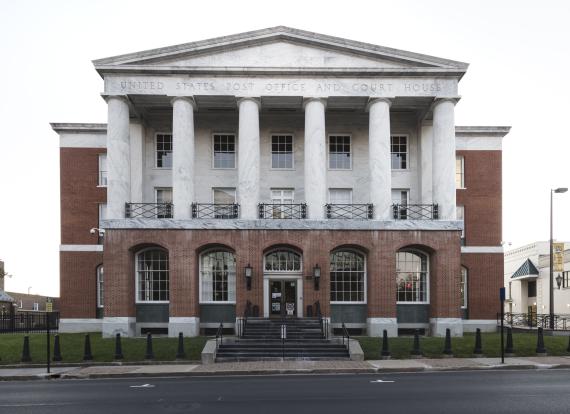
Located at the northeast corner of North Main and East Elizabeth Streets in Harrisonburg’s historic commercial and institutional center, the cruciform-plan U.S. Courthouse has three stories with full basement and penthouse. The Neoclassical exterior is executed in red brick accented with white marble belt courses, engaged pilaster capitals, frieze bands, and cornices. White granite is used for the water table and entrance steps, while greenstone accents the windows on the first and second stories. Multi-light, double-hung, wood windows light the building.
The building’s primary facade fronts west onto North Main Street and is dominated by a three-story portico. The main entrance is centered within the five recessed segmental brick arches at portico’s base. Arched windows flank the entrance and continue across the first story on either side of the portico. On the second and third stories, the portico is composed of a loggia with a colonnade of six Doric columns, pediment, and coffered ceiling executed in grey-veined white marble. Decorative iron railings fill the spaces between the massive columns. The second- and third-story windows have flat lintels, and greenstone sills and spandrel panels sit below the first- and second-story window openings.
The secondary elevations are also comprised of brick masonry with white marble trim. Brick pilasters with marble capitals divide the upper-story bays. The first story typically features arched windows while the second- and third-story windows have flat lintels. Greenstone sills and spandrel panels sit below the first- and second-story window openings. A large, one-story loading dock and a stair tower are attached to the east elevation, while an elevator tower is located on the north elevation.
Although the interior has been modified in a series of campaigns since the 1960s, the building still reflects its original functions, and historic finishes remain in the primary public areas. Within the postal lobby on the first floor, the original lockboxes and service counters have been removed, but the terrazzo floors, black structural glass baseboards, polished marble wainscot, plaster walls and cornices, built-in desks with black structural glass writing surfaces, bulletin boards, building directories, and bronze sconces remain.
The lobby also contains an original mural installed in 1943 and restored in the early 1970s. The Section of Fine Arts, a New Deal art program in the U.S. Treasury Department, selected artist William H. Calfee in 1941, following a regional competition. Calfee was a well-known Washington, D.C.-based artist who received several federal art commissions. The five-foot tall, nearly seventy-five-foot long mural spans three walls and is titled Country Fair, Trading, Courthouse Square. It depicts contemporary life in Harrisonburg in the early 1940s, emphasizing its importance as the market and trading center of Rockingham County.
Originally configured to accommodate federal offices, the second floor was modified with the addition of a new courtroom in 1996. The building’s historic courtroom is located in the center of the third floor. The two-story space remains largely as it was designed, with many of the original finishes and features, including oak door surrounds and wainscot, an ornamental plaster “apse” wall behind the judge’s bench, a decorative plaster and acoustic tile ceiling grid, and quarter-sawn oak court furniture. Most of the historic finishes and features also remain in the courtroom lobby including terrazzo floors, wood doors, marble wainscot and door surrounds, a vaulted plaster ceiling, and pendant lighting fixtures.
Significant Events
1938-1940: Building designed and constructed
1956-1958: Judge John Paul issues landmark desegregation orders
1996: Second floor alterations including new courtroom
2000-2001: Post office vacates and building acquired by GSA
2005: Exterior restoration begins and building is listed in National Register of Historic Places
Building Facts
Location: 116 North Main Street
Architect: Louis A. Simon, Rudolph Stanley-Brown
Construction Dates: 1939-1940
Landmark Status: Listed in the National Register of Historic Places
Architectural Style: Neoclassical Revival
Primary Materials: Brick, granite, and marble
Prominent Features:
- Symmetrical facade with three-story portico
- Marble-wainscoted postal lobby
- New Deal mural
- Oak-wainscoted third-floor courtroom


 U.S. General Services Administration