Countdown to America's 250th Anniversary: 154 days

close

An official website of the United States government

Here’s how you know

Official websites use .gov
A .gov website belongs to an official government organization in the United States.

Secure .gov websites use HTTPS
A lock ( Lock A locked padlock ) or https:// means you’ve safely connected to the .gov website. Share sensitive information only on official, secure websites.

GSA 250 year anniversary logo and seal U.S. General Services Administration
    • Explore buy through us
    • Category management
    • Government property for sale or lease
      Toggle submenu
      • Personal property (tangible goods)
      • Real property (real estate and buildings) for public use
      • Vehicle sales
    • Products and services
      Toggle submenu
      • Human capital
      • Industrial products and services
      • Office management
      • Professional services
      • Security and protection
      • Transportation and logistics services
    • Purchasing programs
      Toggle submenu
      • Assisted acquisition
      • Commercial platforms
      • Federal strategic sourcing initiative
      • Fleet management
      • Governmentwide acquisition contractors
      • HCaTS and HCaTS SB
      • Multiple award schedule, or MAS
      • OASIS and OASIS SB
      • Requisition programs
      • State and local programs
      • Emergency acquisition basic ordering agreements
    • Shared services
      Toggle submenu
      • Payroll services
      • Support services for CABs

    Featured Topics

    • Auctions Federal assets available via auction to the general public.
    • Explore sell to government
    • Step 1: Learn about government contracting
      Toggle submenu
      • Ways you can sell to government
      • How to access contract opportunities
      • Conduct market research
    • Step 2: Compete for a contract
      Toggle submenu
      • Register your business
      • Certify as a small business
      • Become a schedule holder
      • Market your business
      • Research active solicitations
      • Respond to a solicitation
      • What to expect during the award process
    • Step 3: Manage your contract
      Toggle submenu
      • Comply with contractual requirements
      • Handle contract modifications
      • Monitor past performance evaluations

    Featured Topics

    • Contract opportunities on SAM.gov Search current federal contract opportunities and procurement notices.
    • Forecast of contracting opportunities Anticipated contracts offered by GSA.
    • Vendor support center Research the federal market, report sales, and upload contract information.
    • Explore real estate
    • Assets identified for accelerated disposition
    • Child care services
      Toggle submenu
      • Find a child care center
    • Explore historic buildings
      Toggle submenu
      • Explore by architectural style
      • Explore by timeline
      • Find a historic building
    • Leasing
      Toggle submenu
      • Leasing guidance
      • Leasing tools
    • Occupancy Agreement Space Inventory System, or OASIS
    • Reimburseable services program
      Toggle submenu
      • eRETA RWA customer portal
      • eRETA user account request process
    • Water quality management
    • Workplace optimization
      Toggle submenu
      • Answers to FAQs about Space Match
      • Commercial coworking
      • Offerings
      • Space Match
    • USE IT Act and occupancy data
      Toggle submenu
      • Playbook: Federal daily check-in survey
      • Playbook: Laptop occupancy data

    Featured Topics - Real Estate

    • Real property disposal Dispose or acquire excess federal real property including buildings or land.
    • Explore policy and regulations
    • Acquisition policy
    • Aviation management policy
    • Federal Advisory Committee Act management
    • Information technology policy
    • Real property management policy
    • Travel management policy
    • Regulations
      Toggle submenu
      • Federal acquisition regulations
      • Federal management regulations
      • Federal travel regulations

    Featured Topics

    • Forms Search for a government form.
    • Per diem FAQs Frequently asked questions about per diem rates and related topics.
    • Explore small business
    • Small business goals
    • Register your business
      Toggle submenu
      • Explore business models
      • Research the federal market
      • Subcontracting and other partnerships
    • Forecast of contracting opportunities
    • Small business resources
      Toggle submenu
      • Small business contacts
      • Videos

    Featured Topics

    • Forecast tool Information on planned federal contracting opportunities.
    • Socio economic categories Check your eligibility for small-business set-asides.
    • Training resources Suggested training for doing business with us.
    • Explore travel
    • Plan a trip
      Toggle submenu
      • Per diem rates
      • Transportation (airfare rates, POV rates, etc.)
      • Lodging
      • Travel charge card
    • Travel and lodging services
      Toggle submenu
      • E-gov travel service (ETS)
      • Rideshare
      • Travel category schedule
    • Federal travel regulation

    Featured Topics

    • Per diem rates look-up Allowances for lodging, meal and incidental costs while on official government travel.
    • Mileage reimbursement rates Reimbursement rates for the use of your own vehicle while on official government travel.
    • Explore technology
    • Purchasing programs
      Toggle submenu
      • Cloud computing services
      • Cybersecurity products and services
      • Governmentwide acquisition contracts
      • MAS information technology
      • USAccess
    • Government initiatives
      Toggle submenu
      • Artificial Intelligence
      • Cybersecurity
      • Emerging citizen technology
      • FedRAMP
      • Federal identity, credentials, and access management
      • Robotic process automation community
      • Technology modernization fund
    • Training

    Featured Topics

    • Challenge.gov Government sponsored challenges and prize competitions.
    • Data.gov Access U.S. government data.
    • Multiple award schedule IT category Information technology products, services and solutions.
    • Explore about us
    • Background and history
      Toggle submenu
      • Overview
      • Mission and strategic goals
      • Role in presidential transitions
    • Careers
      Toggle submenu
      • Get an internship
      • Launch your career
      • Elevate your professional career
      • Discover special hiring paths
      • Resources and related links
    • Events and training
      Toggle submenu
      • Events, training, and request a speaker
      • Our training programs
    • Newsroom
      Toggle submenu
      • Agency blog
      • Congressional testimony
      • GSA does that podcast
      • News releases
      • Speeches
      • Videos
    • Organization
      Toggle submenu
      • Leadership directory
      • Federal Acquisition Service
      • Public Buildings Service
      • Staff offices
    • Contact us

    Featured Topics

    • Blog Read the latest GSA news, updates and analysis.
    • Careers Learn what we have to offer.
  • Per diem lookup
Buy through us
Explore buy through us
Category management
Government property for sale or lease
Personal property (tangible goods)
Real property (real estate and buildings) for public use
Vehicle sales
Products and services
Human capital
Industrial products and services
Office management
Professional services
Security and protection
Transportation and logistics services
Purchasing programs
Assisted acquisition
Commercial platforms
Federal strategic sourcing initiative
Fleet management
Governmentwide acquisition contractors
HCaTS and HCaTS SB
Multiple award schedule, or MAS
OASIS and OASIS SB
Requisition programs
State and local programs
Emergency acquisition basic ordering agreements
Shared services
Payroll services
Support services for CABs
Sell to government
Explore sell to government
Step 1: Learn about government contracting
Ways you can sell to government
How to access contract opportunities
Conduct market research
Step 2: Compete for a contract
Register your business
Certify as a small business
Become a schedule holder
Market your business
Research active solicitations
Respond to a solicitation
What to expect during the award process
Step 3: Manage your contract
Comply with contractual requirements
Handle contract modifications
Monitor past performance evaluations
Real estate
Explore real estate
Assets identified for accelerated disposition
Child care services
Find a child care center
Explore historic buildings
Explore by architectural style
Explore by timeline
Find a historic building
Leasing
Leasing guidance
Leasing tools
Occupancy Agreement Space Inventory System, or OASIS
Reimburseable services program
eRETA RWA customer portal
eRETA user account request process
Water quality management
Workplace optimization
Answers to FAQs about Space Match
Commercial coworking
Offerings
Space Match
USE IT Act and occupancy data
Playbook: Federal daily check-in survey
Playbook: Laptop occupancy data
Policy and regulations
Explore policy and regulations
Acquisition policy
Aviation management policy
Federal Advisory Committee Act management
Information technology policy
Real property management policy
Travel management policy
Regulations
Federal acquisition regulations
Federal management regulations
Federal travel regulations
Small business
Explore small business
Small business goals
Register your business
Explore business models
Research the federal market
Subcontracting and other partnerships
Forecast of contracting opportunities
Small business resources
Small business contacts
Videos
Travel
Explore travel
Plan a trip
Per diem rates
Transportation (airfare rates, POV rates, etc.)
Lodging
Travel charge card
Travel and lodging services
E-gov travel service (ETS)
Rideshare
Travel category schedule
Federal travel regulation
Technology
Explore technology
Purchasing programs
Cloud computing services
Cybersecurity products and services
Governmentwide acquisition contracts
MAS information technology
USAccess
Government initiatives
Artificial Intelligence
Cybersecurity
Emerging citizen technology
FedRAMP
Federal identity, credentials, and access management
Robotic process automation community
Technology modernization fund
Training
About us
Explore about us
Background and history
Overview
Mission and strategic goals
Role in presidential transitions
Careers
Get an internship
Launch your career
Elevate your professional career
Discover special hiring paths
Resources and related links
Events and training
Events, training, and request a speaker
Our training programs
Newsroom
Agency blog
Congressional testimony
GSA does that podcast
News releases
Speeches
Videos
Organization
Leadership directory
Federal Acquisition Service
Public Buildings Service
Staff offices
Contact us
  1. Home
  2. Real estate
  3. Explore historic buildings
  4. Find a Building
  5. U.S. Custom House, Charleston, SC

U.S. Custom House, Charleston, SC

Location: 200 E Bay St, Charleston, SC 29401

History

U.S. Custom House, Charleston, SC

In mid-nineteenth century Charleston, South Carolina, the U.S. Custom Service had outgrown its offices in the 1771 Exchange Building on East Bay Street. Responding to increased trade activity in the Atlantic port city, Congress appropriated funds in 1847 for the purchase of a site for a new custom house. The waterfront site on the Cooper River, purchased for $130,000 in 1849, was then known as Fitzsimmon’s Wharf.

In early 1850, private architects were invited to compete for the commission to design the building. Ultimately, none of the entries was chosen as submitted, and Supervising Architect of the Treasury Ammi B. Young incorporated elements from four competition drawings into one cohesive design.

Construction began in 1853, with workers finding the remains of a Colonial-era fortification, Craven’s Bastion, while digging the foundation. Due to the marshy location, a grillage of timber was constructed to support the weight of the building. By 1859, the walls and columns had been constructed, but Congress, concerned about escalating costs and the possibility of South Carolina secession, did not appropriate funds needed to complete construction.

The onset of the Civil War brought construction efforts to an indefinite close, and the building sustained considerable damage when it was struck by shells during the bombardment of Charleston. In 1870, work resumed under revised plans that eliminated the original design’s domed cupola and side porticos. The building was completed and occupied nine years later at the total cost of $2.8 million. In 1893, a stone wharf was constructed at the east front of the building.

The building served Charleston into the next century, but in 1956, plans to raze it were announced. Due to widespread support for its preservation, however, the government allocated funds for restoration in the 1960s.

In 1960, the building was included in the designation of the Charleston Historic District, which was in the first group of districts recognized as National Historic Landmarks in the United States. The U.S. Custom House was individually listed in the National Register of Historic Places in 1974.

Architecture

Located in the Charleston Historic District, the U.S. Custom House sits on a site bounded by East Bay, Market, Concord, and Cumberland streets. The building has a cross plan with two facades: the first faces downtown on the west, and the second faces the Charleston Harbor to its east.

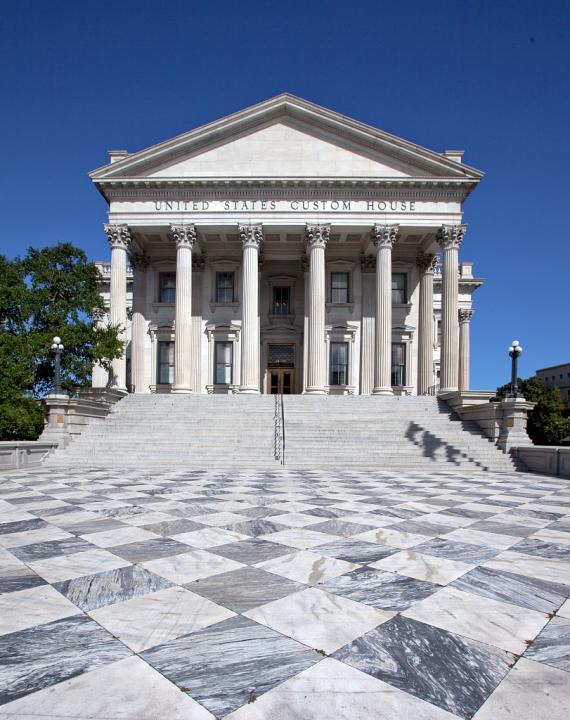
Architect Ammi B. Young incorporated Greek and Roman elements into his Classical design. The three story building sits on a podium, and the east and west facades have temple fronts. The basement story is rusticated granite, and broad steps lead to the main entries on the first floor. The bronze doors have molded limestone surrounds and are topped by triangular pediments supported by acanthus leaf consoles. Windows have a similar treatment, with the acanthus leaf consoles supporting both pediments and sills.
Two-story, limestone Corinthian columns support colossal pedimented porticos on the east and west facades. Aligned with the portico columns, Corinthian pilasters separate the bays on both facades, and engaged fluted columns continue around the building. Above the columns, a full entablature has a molded architrave, wide frieze, and dentiled cornice. The frieze is unadorned except on the west facade, where “United States Custom House” was carved in 1964. A balustrade and low pitched roof top the building.
Lobbies at the east and west entries to the building have floors covered with fossiliferous black and white marble tiles laid in a diamond pattern. In the west lobby, a cast-iron stair with decorative railing leads to the second floor. On the second floor, a narrow circular staircase leads to the attic.

The building’s interior revolves around the two-story cortile, which early records reference as the Business Room. Originally intended to be a rotunda with a sky-lit dome, the cortile is square and spans approximately fifty feet in both directions. Similar to the lobby, black and white marble tiles cover the floor. Fourteen cast-iron Corinthian columns border the space and support an ornate cast-iron balcony. Fluted Corinthian pilasters decorate the second floor walls. A coved, stenciled ceiling with eight artificially lit skylights tops the cortile. Painted red, white, blue, and gold, the ceiling is divided into rectangles adorned with patriotic symbols, including American flags and shields, and classical motifs.

Most offices open onto the cortile. Some offices contain original marble fireplaces with classical carvings including columns and rosettes. Interior doors retain white marble surrounds and some have original embossed door knobs and hinges featuring Treasury Department and Customs Service symbols.

The exterior has changed little since the building was constructed, though the interior has been modernized. In 1906, a modern heating system replaced the original stoves and coal grates, and in 1910, plumbing and electric lighting systems were installed.
After the building was saved from potential demolition, the cortile ceiling was restored in 1968. The second-floor courtroom was restored during the 1990s. Between 2000 and 2011, projects included door and plaster restoration, window refinishing, security and elevator upgrades, and repainting public spaces using original color palettes.

Significant Events

  • 1850: Architects compete to design custom house
  • 1853: Construction begins
  • 1860: South Carolina secedes from United States and construction ceases
  • 1861-1865: Partially completed building sustains damage during Civil War
  • 1870: Construction resumes
  • 1879: Building completed and occupied
  • 1960: Charleston Historic District designated a National Historic Landmark
  • 1968: Cortile ceiling restored
  • 1974: Building listed in the National Register of Historic Places

Facts

  • Architect: Ammi Burnham Young
  • Architectural Style: Classical Revival
  • Construction Dates:1853-1879
  • GSA Building Number: SC0011ZZ
  • Landmark Status: Listed in the National Register of Historic Places
  • Primary Materials: Limestone, granite, marble
  • Prominent Features: Classical pedimented portico with Corinthian columns

Poster Download

U.S. Custom House


Download the poster [PDF - 546 KB]

 

Print Page Email Page
Last updated: Jan 15, 2025
Top

Home

  • Resources for …
    • Americans with Disabilities
    • Citizens and Consumers
    • Federal Employees
    • GSA Employees
    • Native American affairs
    • Presidential & Congressional Commissions, Boards or Small Agencies
    • Small Business
  • Governmentwide Initiatives
    • Centers of Excellence
    • Digital experience
    • Emergency response
    • Federal Cybersecurity
    • ID, Credentials, and Access Management
    • Information Quality
    • Open Data
    • Technology Modernization Fund
  • Contact Us
  • Organization
    • Leadership Directory
    • Staff Directory
  • References
    • Annual reports
    • Plain Language
    • Budget and Performance
    • Catalogs
    • Orders & Directives
    • Forms
  • Website Information
    • A-Z Index
    • Report a website issue
    • Sitemap
  • Also of Interest
    • Data.gov
    • Whitehouse.gov
  • Tools
    • eBuy
    • eLibrary
    • Contracting forecast tool
    • GSA Advantage
    • GSA Auctions
GSA logo
  • Facebook
  • X
  • LinkedIn
  • YouTube
  • instagram
  • Blog
  • email

JOIN THE CONVERSATION

GSA.gov

An official website of the U.S. General Services Administration

  • Accessibility statement
  • Website Policies
  • Reports
  • Office of the Inspector General
  • No FEAR Act
  • FOIA Requests
  • Board of Contract Appeals
Looking for U.S. government information and services?
Visit USA.gov

PER DIEM LOOK-UP

1 Choose a location

Error, The Per Diem API is not responding. Please try again later.

No results could be found for the location you've entered.

Get my location

OR

OR

Rates for Alaska, Hawaii, and U.S. territories and possessions are set by the Department of Defense.

Rates for foreign countries are set by the Department of State.

2 Choose a date


OR

Rates are available between 10/1/2023 and 09/30/2026.

The End Date of your trip can not occur before the Start Date.


Additional terms and conditions

Traveler reimbursement is based on the location of the work activities and not the accommodations, unless lodging is not available at the work activity, then the agency may authorize the rate where lodging is obtained.

Unless otherwise specified, the per diem locality is defined as "all locations within, or entirely surrounded by, the corporate limits of the key city, including independent entities located within those boundaries."

Per diem localities with county definitions shall include"all locations within, or entirely surrounded by, the corporate limits of the key city as well as the boundaries of the listed counties, including independent entities located within the boundaries of the key city and the listed counties (unless otherwise listed separately)."

When a military installation or Government - related facility(whether or not specifically named) is located partially within more than one city or county boundary, the applicable per diem rate for the entire installation or facility is the higher of the rates which apply to the cities and / or counties, even though part(s) of such activities may be located outside the defined per diem locality.