An official website of the United States government

Here’s how you know

Official websites use .gov
A .gov website belongs to an official government organization in the United States.

Secure .gov websites use HTTPS
A lock ( ) or https:// means you’ve safely connected to the .gov website. Share sensitive information only on official, secure websites.

GSA Logo U.S. General Services Administration
    • Explore buy through us
    • Category management
    • Government property for sale or lease
      Toggle submenu
      • Personal property (tangible goods)
      • Real property (real estate and buildings) for public use
      • Real property sales
      • Vehicle sales
    • Products and services
      Toggle submenu
      • Human capital
      • Industrial products and services
      • Office management
      • Professional services
      • Security and protection
      • Transportation and logistics services
    • Purchasing programs
      Toggle submenu
      • Assisted acquisition
      • Commercial platforms
      • Federal strategic sourcing initiative
      • Fleet management
      • HCaTS and HCaTS SB
      • OASIS and OASIS SB
      • Requisition programs
      • State and local programs
      • Emergency acquisition basic ordering agreements
    • Shared services
      Toggle submenu
      • Payroll services
      • Support services for CABs

    Featured Topics

    • Multiple Award Schedule Governmentwide contracts for products and services at volume discount pricing.
    • Auctions Federal assets available via auction to the general public.
    • Explore sell to government
    • Step 1: Learn about government contracting
      Toggle submenu
      • Ways you can sell to government
      • How to access contract opportunities
      • Conduct market research
    • Step 2: Compete for a contract
      Toggle submenu
      • Register your business
      • Certify as a small business
      • Become a schedule holder
      • Market your business
      • Research active solicitations
      • Respond to a solicitation
      • What to expect during the award process
    • Step 3: Manage your contract
      Toggle submenu
      • Comply with contractual requirements
      • Handle contract modifications
      • Monitor past performance evaluations

    Featured Topics

    • Contract opportunities on SAM.gov Search current federal contract opportunities and procurement notices.
    • Forecast of contracting opportunities Anticipated contracts offered by GSA.
    • Vendor support center Research the federal market, report sales, and upload contract information.
    • Explore real estate
    • Design and construction
      Toggle submenu
      • 3D-4D building information modeling
      • Computer-aided design standards
      • Engineering
      • Project management information system
      • Prospectus thresholds
    • Facilities management
      Toggle submenu
      • Security
      • Tenant services
      • Water quality management
    • Our properties
      Toggle submenu
      • Owned and leased properties
      • Renting property
    • Real estate services
      Toggle submenu
      • Leasing resources
      • Real property disposal
      • Reimbursable services (RWA)
      • For businesses seeking opportunities
      • For workers in federal buildings
      • Voice of the customer
    • Workplace optimization
      Toggle submenu
      • Commercial coworking
      • Space Match
    • Explore historic buildings

    Featured Topics - Real Estate

    • Historic preservation tools and resources Procedures for maintaining and repairing historic buildings.
    • Real property disposal Dispose or acquire excess federal real property including buildings or land.
    • Explore policy and regulations
    • Acquisition policy
    • Aviation management policy
    • Federal Advisory Committee Act management
    • Information technology policy
    • Real property management policy
    • Travel management policy
    • Regulations
      Toggle submenu
      • Federal acquisition regulations
      • Federal management regulations
      • Federal travel regulations

    Featured Topics

    • Forms Search for a government form.
    • Per diem FAQs Frequently asked questions about per diem rates and related topics.
    • Explore small business
    • Small business goals
    • Register your business
      Toggle submenu
      • Explore business models
      • Research the federal market
      • Subcontracting and other partnerships
    • Forecast of contracting opportunities
    • Small business resources
      Toggle submenu
      • Small business contacts
      • Videos

    Featured Topics

    • Forecast tool Information on planned federal contracting opportunities.
    • Socio economic categories Check your eligibility for small-business set-asides.
    • Training resources Suggested training for doing business with us.
    • Explore travel
    • Plan a trip
      Toggle submenu
      • Per diem rates
      • Transportation (airfare rates, POV rates, etc.)
      • Lodging
      • Travel charge card
    • Travel and lodging services
      Toggle submenu
      • E-gov travel service (ETS)
      • Rideshare
      • Travel category schedule
    • Federal travel regulation

    Featured Topics

    • Per diem rates look-up Allowances for lodging, meal and incidental costs while on official government travel.
    • Mileage reimbursement rates Reimbursement rates for the use of your own vehicle while on official government travel.
    • Explore technology
    • Purchasing programs
      Toggle submenu
      • Cloud computing services
      • Cybersecurity products and services
      • Governmentwide acquisition contracts
      • MAS information technology
      • USAccess
    • Government initiatives
      Toggle submenu
      • Artificial Intelligence
      • Cybersecurity
      • Emerging citizen technology
      • FedRAMP
      • Federal identity, credentials, and access management
      • Robotic process automation community
      • Technology modernization fund
    • Training

    Featured Topics

    • Challenge.gov Government sponsored challenges and prize competitions.
    • Data.gov Access U.S. government data.
    • Multiple award schedule IT category Information technology products, services and solutions.
    • Explore about us
    • Background and history
      Toggle submenu
      • Overview
      • Mission and strategic goals
      • Role in presidential transitions
    • Careers
      Toggle submenu
      • Get an internship
      • Launch your career
      • Elevate your professional career
      • Discover special hiring paths
      • Resources and related links
    • Events and training
      Toggle submenu
      • Events, training, and request a speaker
      • Our training programs
    • Newsroom
      Toggle submenu
      • Agency blog
      • Congressional testimony
      • GSA does that podcast
      • News releases
      • Speeches
      • Videos
    • Organization
      Toggle submenu
      • Leadership directory
      • Federal Acquisition Service
      • Public Buildings Service
      • Staff offices
    • Contact us

    Featured Topics

    • Blog Read the latest GSA news, updates and analysis.
    • Careers Learn what we have to offer.
  • Per diem lookup
Buy through us
Explore buy through us
Category management
Government property for sale or lease
Personal property (tangible goods)
Real property (real estate and buildings) for public use
Real property sales
Vehicle sales
Products and services
Human capital
Industrial products and services
Office management
Professional services
Security and protection
Transportation and logistics services
Purchasing programs
Assisted acquisition
Commercial platforms
Federal strategic sourcing initiative
Fleet management
HCaTS and HCaTS SB
OASIS and OASIS SB
Requisition programs
State and local programs
Emergency acquisition basic ordering agreements
Shared services
Payroll services
Support services for CABs
Sell to government
Explore sell to government
Step 1: Learn about government contracting
Ways you can sell to government
How to access contract opportunities
Conduct market research
Step 2: Compete for a contract
Register your business
Certify as a small business
Become a schedule holder
Market your business
Research active solicitations
Respond to a solicitation
What to expect during the award process
Step 3: Manage your contract
Comply with contractual requirements
Handle contract modifications
Monitor past performance evaluations
Real estate
Explore real estate
Design and construction
3D-4D building information modeling
Computer-aided design standards
Engineering
Project management information system
Prospectus thresholds
Facilities management
Security
Tenant services
Water quality management
Our properties
Owned and leased properties
Renting property
Real estate services
Leasing resources
Real property disposal
Reimbursable services (RWA)
For businesses seeking opportunities
For workers in federal buildings
Voice of the customer
Workplace optimization
Commercial coworking
Space Match
Explore historic buildings
Policy and regulations
Explore policy and regulations
Acquisition policy
Aviation management policy
Federal Advisory Committee Act management
Information technology policy
Real property management policy
Travel management policy
Regulations
Federal acquisition regulations
Federal management regulations
Federal travel regulations
Small business
Explore small business
Small business goals
Register your business
Explore business models
Research the federal market
Subcontracting and other partnerships
Forecast of contracting opportunities
Small business resources
Small business contacts
Videos
Travel
Explore travel
Plan a trip
Per diem rates
Transportation (airfare rates, POV rates, etc.)
Lodging
Travel charge card
Travel and lodging services
E-gov travel service (ETS)
Rideshare
Travel category schedule
Federal travel regulation
Technology
Explore technology
Purchasing programs
Cloud computing services
Cybersecurity products and services
Governmentwide acquisition contracts
MAS information technology
USAccess
Government initiatives
Artificial Intelligence
Cybersecurity
Emerging citizen technology
FedRAMP
Federal identity, credentials, and access management
Robotic process automation community
Technology modernization fund
Training
About us
Explore about us
Background and history
Overview
Mission and strategic goals
Role in presidential transitions
Careers
Get an internship
Launch your career
Elevate your professional career
Discover special hiring paths
Resources and related links
Events and training
Events, training, and request a speaker
Our training programs
Newsroom
Agency blog
Congressional testimony
GSA does that podcast
News releases
Speeches
Videos
Organization
Leadership directory
Federal Acquisition Service
Public Buildings Service
Staff offices
Contact us
  1. Home
  2. Real estate
  3. Historic preservation
  4. Explore historic buildings
  5. Find a Building
  6. David W. Dyer Federal Building and U.S. Courthouse, Miami, FL

David W. Dyer Federal Building and U.S. Courthouse, Miami, FL

Location: 300 NE 1st Ave, Miami, FL 33132

History

Dyer Federal Building, Miami, Florida

In 1887, railroad and real estate tycoon Henry Flagler hired the renowned New York architectural firm of Carrere & Hastings to design the Ponce de Leon Hotel in St. Augustine, Florida. The hotel’s Mediterranean Revival design was so successful that it influenced numerous Florida architects and became the principal aesthetic in the Miami area from the mid-1910s into the 1930s.

In 1926, a devastating hurricane decimated southern Florida. When Congress appropriated more than $2 million for a new courthouse in Miami in 1928, the city was ready for renewal. The Office of the Supervising Architect of the Treasury selected the highly regarded architectural partnership of Phineas E. Paist and Harold D. Steward. Designing the building between 1930 and 1931, Paist and Steward expertly blended classically inspired Renaissance Revival forms and design elements with Mediterranean ornamentation. Paist was one of developer George Merrick’s primary architects for the Miami suburb of Coral Gables in the 1920s. There he executed many Mediterranean Revival buildings, most notably the renowned Venetian Pool. From the 1920s through the 1940s, Steward and Paist collaborated on projects including the Florida pavilion for the 1933 Chicago World’s Fair.

Paist and Steward developed two sets of plans, each to be built upon a poured concrete and steel structural frame, ensuring the new federal building would resist hurricane-force winds. The first envisioned using imported marble and bronze, while the second was to use aluminum and a local coralline limestone, a lithified coral quarried at Windley Key near Key Largo and called Keystone. The government opted to clad the building in Keystone, reasoning that local materials added to the regional appeal of the building. Construction commenced in 1931 and the opening ceremony was held on July 1, 1933. It is the most monumental Keystone structure in South Florida.

When it opened, the building housed all Miami-area federal agencies with the exception of the Weather Service. The U.S. Postal Service vacated the building in 1976. In 2008, occupants were relocated into a newly constructed courthouse and the building became mostly vacant. In 2016, it was leased to Miami Dade College. It is contained within Federal Courthouse Square, a two-block area that includes two other courthouses.

The building was listed in the National Register of Historic Places in 1983. In 1997, it was renamed to honor David W. Dyer, a former Chief Judge of Florida’s Southern District Court, who was appointed to the Circuit Court of Appeals in 1966.

Architecture

The David W. Dyer Federal Building and U.S. Courthouse is a skillful example of Mediterranean Revival architecture that combines Renaissance Revival elements with regional Florida architectural features. The building, which is faced in Keystone, is three stories in height, with the third story set above a widely projecting entablature on the north, east, and south elevations.

The facade, which has a slightly projecting central bay, faces east onto First Avenue and is dominated by a colonnade comprised of regularly spaced engaged Corinthian columns supporting the classical entablature crowning the second story. Cast-aluminum casement window frames have embossed repeating chevron pat-terns. Spandrel panels depicting scenes from Florida’s history are above the second story’s arched windows.

The bays adjoining the colonnade feature paired Corinthian pilasters. Bas relief medallions containing classical figures in profile decorate lintels. The central parapet features a carved marble frieze incorporating a large eagle, flanked by a repeating motif of pelicans supporting heraldic shields. The entrances at the ends of the facade have surrounds of carved Floridene buff marble. The north and south elevations feature two-story Corinthian pilasters evoking the facade’s colonnade. Ornate mascarons (carved faces) are found on the building’s exterior.

The north and south elevations are dominated by central pavilions with bays separated by evenly spaced two-story engaged columns, placed singly and in pairs. An annex is attached to the west elevation. The building’s shallow hipped roof is covered with terra-cotta tiles, typical of the Mediterranean Revival style.

Interior spaces are equally elaborate and incorporate eleven different types of marble. Entry vestibules with arched openings lead to the main lobby, where marble covers floors and forms wainscot. Marble pilasters have striking gilt capitals. An inset, multi-colored marble star pattern adorns the center of the floor. Original aluminum and glass chandeliers hang from the painted and gilt wood-and-plaster coffered ceiling. Marble postal tables retain original lamps and inset cast-brass grilles.

The double-height ceremonial District Courtroom is another significant space with well-preserved original details, including the carved wooden judge’s bench, jury box, witness stand, and clerk’s desk. Decorative details include fluted pilasters, rosettes, and carved plaques with floral rinceaux. At the walls, seven feet of paneled wood wainscot is located beneath scored plaster. Marble Ionic pilasters divide the window openings.

The mural Law Guides Florida Progress completed by artist Denman Fink in 1941 is located above the judge’s bench and is flanked by two pairs of Ionic marble pilasters. The mural depicts the positive impact of justice guiding Florida’s economic development. Fink included a likeness of himself as a draftsman and a likeness of architect Phineas E. Paist, with whom he worked in Coral Gables, as a chemist. The coffered ceiling features rosettes, stars, and shells.

Other significant artwork in the courthouse includes two striking cast-stone lunettes by Yugoslav-born American artist Alexander Sambugnac. Executed in 1938, the low-relief panels portray two allegorical figures representing themes of the spirit of justice and are placed on the lintels above the leather-covered doors. Love and Hope shows a young woman playing the lyre, while Wisdom and Courage depicts a seated figure gazing at a tablet of the law.

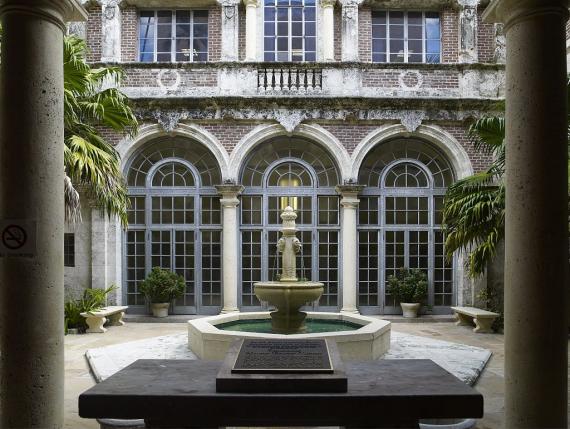
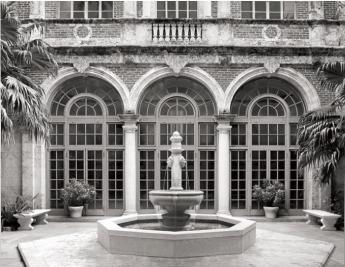
The interior brick courtyard admits light into the building while also providing a beautiful outdoor space commonly found in Florida architecture. A two-story loggia with a vaulted ceiling and columns surrounds the courtyard on three sides. Keystone pilasters support arched lunette windows above the public lobby’s paired French doors. Quoins (corner blocks) and Doric columns add decorative elements to the space. The courtyard’s interior walls are unplastered brick, as are the exterior walls that face toward the courtyard from the north, east and south wings. The loggia’s plaster walls and ceiling are ornamented with the multi-colored Frescoes in Courtyard, added by artist David Novros in 1984. An original postal marble writing table with an elaborate pedestal occupies the west side of the courtyard.

Significant Events

  • 1928: Congress appropriates money for new federal courthouse in Miami.
  • 1930-1931: Architects Paist and Steward design building.
  • 1931-1933: Building constructed.
  • 1983: Building listed in the National Register of Historic Places.
  • 1997: Building renamed to honor Judge David W. Dyer.

Facts

  • Architects: Phineas E. Paist and Harold D. Steward
  • Architectural Style: Mediterranean Revival
  • Construction Dates: 1931-1933
  • GSA Building Number: FL0029AD
  • National Register of Historic Places Landmark Status: National Register Listed
  • Primary Material: Keystone
  • Prominent Features: elaborate Classical facade; interior courtyard and galleries; ceremonial courtroom

Poster Download

poster of David W. Dyer Federal Building & U.S. Courthouse, Miami, FL


Download the poster [PDF - 721 KB]


Print Page Email Page
Last updated: Jan 31, 2025
Top

Home

  • Resources for …
    • Americans with Disabilities
    • Citizens and Consumers
    • Federal Employees
    • GSA Employees
    • Native American affairs
    • Presidential & Congressional Commissions, Boards or Small Agencies
    • Small Business
  • Governmentwide Initiatives
    • Centers of Excellence
    • Digital experience
    • Emergency response
    • Federal Cybersecurity
    • ID, Credentials, and Access Management
    • Information Quality
    • Open Data
    • Technology Modernization Fund
  • Contact Us
  • Organization
    • Leadership Directory
    • Staff Directory
  • References
    • Annual reports
    • Plain Language
    • Budget and Performance
    • Catalogs
    • Orders & Directives
    • Forms
  • Website Information
    • A-Z Index
    • Report a website issue
    • Sitemap
  • Also of Interest
    • Data.gov
    • Whitehouse.gov
  • Tools
    • eBuy
    • eLibrary
    • Contracting forecast tool
    • GSA Advantage
    • GSA Auctions
GSA logo
  • Facebook
  • X
  • LinkedIn
  • YouTube
  • instagram
  • Blog
  • email

JOIN THE CONVERSATION

GSA.gov

An official website of the U.S. General Services Administration

  • Accessibility statement
  • Website Policies
  • Reports
  • Office of the Inspector General
  • No FEAR Act
  • FOIA Requests
  • Board of Contract Appeals
Looking for U.S. government information and services?
Visit USA.gov

PER DIEM LOOK-UP

1 Choose a location

Error, The Per Diem API is not responding. Please try again later.

No results could be found for the location you've entered.

Get my location

OR

OR

Rates for Alaska, Hawaii, and U.S. territories and possessions are set by the Department of Defense.

Rates for foreign countries are set by the Department of State.

2 Choose a date


OR

Rates are available between 10/1/2023 and 09/30/2026.

The End Date of your trip can not occur before the Start Date.


Additional terms and conditions

Traveler reimbursement is based on the location of the work activities and not the accommodations, unless lodging is not available at the work activity, then the agency may authorize the rate where lodging is obtained.

Unless otherwise specified, the per diem locality is defined as "all locations within, or entirely surrounded by, the corporate limits of the key city, including independent entities located within those boundaries."

Per diem localities with county definitions shall include"all locations within, or entirely surrounded by, the corporate limits of the key city as well as the boundaries of the listed counties, including independent entities located within the boundaries of the key city and the listed counties (unless otherwise listed separately)."

When a military installation or Government - related facility(whether or not specifically named) is located partially within more than one city or county boundary, the applicable per diem rate for the entire installation or facility is the higher of the rates which apply to the cities and / or counties, even though part(s) of such activities may be located outside the defined per diem locality.