An official website of the United States government

Here’s how you know

Official websites use .gov
A .gov website belongs to an official government organization in the United States.

Secure .gov websites use HTTPS
A lock ( ) or https:// means you’ve safely connected to the .gov website. Share sensitive information only on official, secure websites.

GSA Logo U.S. General Services Administration
    • Explore buy through us
    • Category management
    • Government property for sale or lease
      Toggle submenu
      • Personal property (tangible goods)
      • Real property (real estate and buildings) for public use
      • Real property sales
      • Vehicle sales
    • Products and services
      Toggle submenu
      • Human capital
      • Industrial products and services
      • Office management
      • Professional services
      • Security and protection
      • Transportation and logistics services
    • Purchasing programs
      Toggle submenu
      • Assisted acquisition
      • Commercial platforms
      • Federal strategic sourcing initiative
      • Fleet management
      • HCaTS and HCaTS SB
      • OASIS and OASIS SB
      • Requisition programs
      • State and local programs
      • Emergency acquisition basic ordering agreements
    • Shared services
      Toggle submenu
      • Payroll services
      • Support services for CABs

    Featured Topics

    • Multiple Award Schedule Governmentwide contracts for products and services at volume discount pricing.
    • Auctions Federal assets available via auction to the general public.
    • Explore sell to government
    • Step 1: Learn about government contracting
      Toggle submenu
      • Ways you can sell to government
      • How to access contract opportunities
      • Conduct market research
    • Step 2: Compete for a contract
      Toggle submenu
      • Register your business
      • Certify as a small business
      • Become a schedule holder
      • Market your business
      • Research active solicitations
      • Respond to a solicitation
      • What to expect during the award process
    • Step 3: Manage your contract
      Toggle submenu
      • Comply with contractual requirements
      • Handle contract modifications
      • Monitor past performance evaluations

    Featured Topics

    • Contract opportunities on SAM.gov Search current federal contract opportunities and procurement notices.
    • Forecast of contracting opportunities Anticipated contracts offered by GSA.
    • Vendor support center Research the federal market, report sales, and upload contract information.
    • Explore real estate
    • Design and construction
      Toggle submenu
      • 3D-4D building information modeling
      • Computer-aided design standards
      • Engineering
      • Project management information system
      • Prospectus thresholds
    • Facilities management
      Toggle submenu
      • Security
      • Tenant services
      • Water quality management
    • Our properties
      Toggle submenu
      • Owned and leased properties
      • Renting property
    • Real estate services
      Toggle submenu
      • Leasing resources
      • Real property disposal
      • Reimbursable services (RWA)
      • For businesses seeking opportunities
      • For workers in federal buildings
      • Voice of the customer
    • Workplace optimization
      Toggle submenu
      • Commercial coworking
      • Space Match
    • Explore historic buildings

    Featured Topics - Real Estate

    • Historic preservation tools and resources Procedures for maintaining and repairing historic buildings.
    • Real property disposal Dispose or acquire excess federal real property including buildings or land.
    • Explore policy and regulations
    • Acquisition policy
    • Aviation management policy
    • Federal Advisory Committee Act management
    • Information technology policy
    • Real property management policy
    • Travel management policy
    • Regulations
      Toggle submenu
      • Federal acquisition regulations
      • Federal management regulations
      • Federal travel regulations

    Featured Topics

    • Forms Search for a government form.
    • Per diem FAQs Frequently asked questions about per diem rates and related topics.
    • Explore small business
    • Small business goals
    • Register your business
      Toggle submenu
      • Explore business models
      • Research the federal market
      • Subcontracting and other partnerships
    • Forecast of contracting opportunities
    • Small business resources
      Toggle submenu
      • Small business contacts
      • Videos

    Featured Topics

    • Forecast tool Information on planned federal contracting opportunities.
    • Socio economic categories Check your eligibility for small-business set-asides.
    • Training resources Suggested training for doing business with us.
    • Explore travel
    • Plan a trip
      Toggle submenu
      • Per diem rates
      • Transportation (airfare rates, POV rates, etc.)
      • Lodging
      • Travel charge card
    • Travel and lodging services
      Toggle submenu
      • E-gov travel service (ETS)
      • Rideshare
      • Travel category schedule
    • Federal travel regulation

    Featured Topics

    • Per diem rates look-up Allowances for lodging, meal and incidental costs while on official government travel.
    • Mileage reimbursement rates Reimbursement rates for the use of your own vehicle while on official government travel.
    • Explore technology
    • Purchasing programs
      Toggle submenu
      • Cloud computing services
      • Cybersecurity products and services
      • Governmentwide acquisition contracts
      • MAS information technology
      • USAccess
    • Government initiatives
      Toggle submenu
      • Artificial Intelligence
      • Cybersecurity
      • Emerging citizen technology
      • FedRAMP
      • Federal identity, credentials, and access management
      • Robotic process automation community
      • Technology modernization fund
    • Training

    Featured Topics

    • Challenge.gov Government sponsored challenges and prize competitions.
    • Data.gov Access U.S. government data.
    • Multiple award schedule IT category Information technology products, services and solutions.
    • Explore about us
    • Background and history
      Toggle submenu
      • Overview
      • Mission and strategic goals
      • Role in presidential transitions
    • Careers
      Toggle submenu
      • Get an internship
      • Launch your career
      • Elevate your professional career
      • Discover special hiring paths
      • Resources and related links
    • Events and training
      Toggle submenu
      • Events, training, and request a speaker
      • Our training programs
    • Newsroom
      Toggle submenu
      • Agency blog
      • Congressional testimony
      • GSA does that podcast
      • News releases
      • Speeches
      • Videos
    • Organization
      Toggle submenu
      • Leadership directory
      • Federal Acquisition Service
      • Public Buildings Service
      • Staff offices
    • Contact us

    Featured Topics

    • Blog Read the latest GSA news, updates and analysis.
    • Careers Learn what we have to offer.
  • Per diem lookup
Buy through us
Explore buy through us
Category management
Government property for sale or lease
Personal property (tangible goods)
Real property (real estate and buildings) for public use
Real property sales
Vehicle sales
Products and services
Human capital
Industrial products and services
Office management
Professional services
Security and protection
Transportation and logistics services
Purchasing programs
Assisted acquisition
Commercial platforms
Federal strategic sourcing initiative
Fleet management
HCaTS and HCaTS SB
OASIS and OASIS SB
Requisition programs
State and local programs
Emergency acquisition basic ordering agreements
Shared services
Payroll services
Support services for CABs
Sell to government
Explore sell to government
Step 1: Learn about government contracting
Ways you can sell to government
How to access contract opportunities
Conduct market research
Step 2: Compete for a contract
Register your business
Certify as a small business
Become a schedule holder
Market your business
Research active solicitations
Respond to a solicitation
What to expect during the award process
Step 3: Manage your contract
Comply with contractual requirements
Handle contract modifications
Monitor past performance evaluations
Real estate
Explore real estate
Design and construction
3D-4D building information modeling
Computer-aided design standards
Engineering
Project management information system
Prospectus thresholds
Facilities management
Security
Tenant services
Water quality management
Our properties
Owned and leased properties
Renting property
Real estate services
Leasing resources
Real property disposal
Reimbursable services (RWA)
For businesses seeking opportunities
For workers in federal buildings
Voice of the customer
Workplace optimization
Commercial coworking
Space Match
Explore historic buildings
Policy and regulations
Explore policy and regulations
Acquisition policy
Aviation management policy
Federal Advisory Committee Act management
Information technology policy
Real property management policy
Travel management policy
Regulations
Federal acquisition regulations
Federal management regulations
Federal travel regulations
Small business
Explore small business
Small business goals
Register your business
Explore business models
Research the federal market
Subcontracting and other partnerships
Forecast of contracting opportunities
Small business resources
Small business contacts
Videos
Travel
Explore travel
Plan a trip
Per diem rates
Transportation (airfare rates, POV rates, etc.)
Lodging
Travel charge card
Travel and lodging services
E-gov travel service (ETS)
Rideshare
Travel category schedule
Federal travel regulation
Technology
Explore technology
Purchasing programs
Cloud computing services
Cybersecurity products and services
Governmentwide acquisition contracts
MAS information technology
USAccess
Government initiatives
Artificial Intelligence
Cybersecurity
Emerging citizen technology
FedRAMP
Federal identity, credentials, and access management
Robotic process automation community
Technology modernization fund
Training
About us
Explore about us
Background and history
Overview
Mission and strategic goals
Role in presidential transitions
Careers
Get an internship
Launch your career
Elevate your professional career
Discover special hiring paths
Resources and related links
Events and training
Events, training, and request a speaker
Our training programs
Newsroom
Agency blog
Congressional testimony
GSA does that podcast
News releases
Speeches
Videos
Organization
Leadership directory
Federal Acquisition Service
Public Buildings Service
Staff offices
Contact us
  1. Home
  2. Real estate
  3. Historic preservation
  4. Explore historic buildings
  5. Find a Building
  6. Pension Building (National Building Museum), Washington, DC

Pension Building (National Building Museum), Washington, DC

Location: 401 F St NW, Washington, DC 20001

History

Pension Building, Washington DC

The Pension Building, now the National Building Museum, stands as a memorial to Civil War veterans. From 1887- 1926, the Pension Bureau distributed $8,300,000 in benefits to 2,763,063 veterans (and their survivors) of the Revolutionary War, the War of 1812, the Mexican War, and the Civil War.

In 1881 the U.S. Congress directed General Montgomery C. Meigs (1816-1892), Quartermaster of the U.S. Army and a graduate of West Point, to develop a fireproof building for the Pension Bureau. Meigs envisioned the building as both office space and as a monument to those who died fighting in the Civil War. In commemoration of those heroes, Caspar Buberl (1834-1899) sculpted a 1200-foot terra cotta frieze depicting the Union’s Army and Navy.

Construction began in 1882 and ended in 1887. Seeking to create a light and airy environment for federal workers, Meigs incorporated numerous ingenious engineering innovations into the structure, his last project. Responsible for such important engineering feats as the Capitol Dome, Meigs considered the Pension Building to be his greatest achievement. Others did not agree, disparaging it as “Meigs’s old red barn.”

When the Pension Bureau became part of the U.S. Veterans Administration in 1930, the U.S. General Accounting Office (GAO) took over the building. An approved expansion plan was abandoned due to concern that an enlarged Pension Building would reduce space for growth of the nearby Courts. By 1950, when GAO moved into its own modern facility, the Pension Building was considered obsolete and demolition was contemplated.

Public perceptions of the building began changing in the late 1950s when an exhibition by the American Institute of Architects promoted it as worth preservation. In 1969 it was listed in the National Register of Historic Places. In 1980 an Act of Congress designated the Pension Building as the site of a new museum celebrating American achievements in the building arts. The National Building Museum opened in 1985, the same year the building was designated a National Historic Landmark.

Architecture

The monumental Pension Building was a technological achievement at the time of its construction in 1882 and a fitting tribute to those who served in the Civil War. The red-brick building, measuring 400 feet by 200 feet, occupies the entire city block bounded by Fourth, Fifth, F, and G Streets, N.W., in downtown Washington, DC.

Massive in size and scale, the Italianate Renaissance Revival building is twenty-seven bays long on the north and south elevations and thirteen bays wide on the west and east elevations. The lower exterior facades are modeled after Antonio da Sangallo’s Palazzo Farnese in Rome. The exterior walls are load-bearing brick, measuring 75 feet high and 2 feet 4 inches thick. They are composed of common brick faced with pressed brick, decorative masonry, and ornamental terra cotta. This was an early use of ornamental terra cotta, which was an affordable substitute for carved stone or iron. The terra cotta frieze designed by Bohemian-born sculptor Caspar Buberl depicts a continuous parade of Civil War military units represented in six themes—infantry, cavalry, artillery, navy, medicine, and quartermaster. The entrances centered on each elevation are defined by projecting brick archways. The main frieze of each entry is ornamented with carved panels depicting the military units of the Civil War. The western entry is the Gate of the Quartermaster, the southern entry is the Gate of the Infantry, the eastern entry is the Naval Gate, and the northern entry is the Gate of the Invalids.

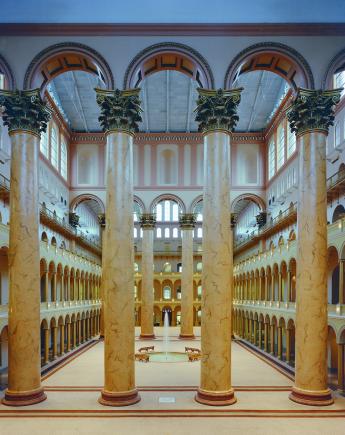
The interior plan of the Pension Building is dominated by a full-height hall or atrium at the center, with interconnecting rooms at the perimeter. The Great Hall is divided into three courts by two sets of four colossal Corinthian columns, supporting the metal and glass roof structure. Each column rises 75 feet, rests on a base 8 feet in diameter, and is crowned by a molded plaster capital and an abacus of cast iron. The cornice has two hundred forty-four niches containing life-size plaster busts representing eight prototypical Americans of the building world. A terra cotta-trimmed circular fountain is located in the center of the Great Hall.

Lining the perimeter of the Great Hall are brick arches that spring from seventy-two cast-iron Ionic columns, creating two levels of open arcaded galleries that serve as corridors to offices on the first and second floors. Four main stairways, centrally located on each side of the building near the entrances, extend from the first to the third floors. The office of the Pension Commissioner on the second floor retains its original fireplace and the only decorated ceiling original to the building.

Numerous technological innovations were incorporated into the building’s design. A fresh air ventilation system was based on the premise that the central atrium could act as a giant flue. The exposed roof structure, ornate fenestration, and the full height of the Great Hall acted as a chimney to exhaust unwanted heat. Air was automatically drawn from the perimeter of the building through the clerestory windows, which were opened by a mechanical system. The large central hall with perimeter offices ensured there were no dark corridors, with daylight and air permeating every space.

In anticipation of use as the National Building Museum, the first renovation phase of the Great Hall was completed in early 1985. The roof was replaced and the facades and terra cotta frieze were restored. As part of the U.S. General Services Administration’s Art in Architecture program, four markers representing themes associated with the building arts were designed in 1990 by sculptor Raymond Kaskey and placed at each corner of the site. In 1991 extensive research was conducted prior to conservation of the Casper Buberl painted terra cotta panels located in the stairwells of the building. Restoration work continued through the 1990s under the direction of the Smith Group.

Significant Events

  • 1881: Army Quartermaster General Montgomery C. Meigs designs the Pension Building.
  • 1882-1887: The Pension Building is constructed.
  • 1930: The Pension Building becomes the U.S. General Accounting Office.
  • 1934: Congress authorizes expansion of the Pension Building to continue serving the U.S. General Accounting Office. The plan is not implemented.
  • 1950: The U.S. General Accounting Office vacates the building and the U.S. Civil Service Commission becomes the primary tenant.
  • 1967: The U.S. General Services Administration commissions a study for the Pension Building and rehabilitation is recommended.
  • 1969: The Pension Building is listed in the National Register of Historic Places.
  • 1972-1978: The DC Superior Court occupies the building.
  • 1980: The building is designated by an Act of Congress as the site of the new National Building Museum.
  • 1985: The Pension Building is designated a National Historic Landmark.

Facts

  • Architect: Army Quartermaster General Montgomery C. Meigs
  • Architectural Style: Italian Renaissance Revival
  • Construction Dates: 1882-1887
  • GSA Building Number: DC0030ZZ
  • Landmark Status: National Historic Landmark
  • Primary Materials: Red brick with brick and terra cotta ornament
  • Prominent Features: Great Hall with 75-foot high columns; Exterior terra cotta frieze of Civil War military units by sculptor Caspar Buberl

Poster Download

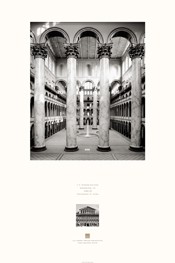
poster of U.S. Pension Building


Download the poster [PDF - 396 KB]


Print Page Email Page
Last updated: Jan 29, 2025
Top

Home

  • Resources for …
    • Americans with Disabilities
    • Citizens and Consumers
    • Federal Employees
    • GSA Employees
    • Native American affairs
    • Presidential & Congressional Commissions, Boards or Small Agencies
    • Small Business
  • Governmentwide Initiatives
    • Centers of Excellence
    • Digital experience
    • Emergency response
    • Federal Cybersecurity
    • ID, Credentials, and Access Management
    • Information Quality
    • Open Data
    • Technology Modernization Fund
  • Contact Us
  • Organization
    • Leadership Directory
    • Staff Directory
  • References
    • Annual reports
    • Plain Language
    • Budget and Performance
    • Catalogs
    • Orders & Directives
    • Forms
  • Website Information
    • A-Z Index
    • Report a website issue
    • Sitemap
  • Also of Interest
    • Data.gov
    • Whitehouse.gov
  • Tools
    • eBuy
    • eLibrary
    • Contracting forecast tool
    • GSA Advantage
    • GSA Auctions
GSA logo
  • Facebook
  • X
  • LinkedIn
  • YouTube
  • instagram
  • Blog
  • email

JOIN THE CONVERSATION

GSA.gov

An official website of the U.S. General Services Administration

  • Accessibility statement
  • Website Policies
  • Reports
  • Office of the Inspector General
  • No FEAR Act
  • FOIA Requests
  • Board of Contract Appeals
Looking for U.S. government information and services?
Visit USA.gov

PER DIEM LOOK-UP

1 Choose a location

Error, The Per Diem API is not responding. Please try again later.

No results could be found for the location you've entered.

Get my location

OR

OR

Rates for Alaska, Hawaii, and U.S. territories and possessions are set by the Department of Defense.

Rates for foreign countries are set by the Department of State.

2 Choose a date


OR

Rates are available between 10/1/2023 and 09/30/2026.

The End Date of your trip can not occur before the Start Date.


Additional terms and conditions

Traveler reimbursement is based on the location of the work activities and not the accommodations, unless lodging is not available at the work activity, then the agency may authorize the rate where lodging is obtained.

Unless otherwise specified, the per diem locality is defined as "all locations within, or entirely surrounded by, the corporate limits of the key city, including independent entities located within those boundaries."

Per diem localities with county definitions shall include"all locations within, or entirely surrounded by, the corporate limits of the key city as well as the boundaries of the listed counties, including independent entities located within the boundaries of the key city and the listed counties (unless otherwise listed separately)."

When a military installation or Government - related facility(whether or not specifically named) is located partially within more than one city or county boundary, the applicable per diem rate for the entire installation or facility is the higher of the rates which apply to the cities and / or counties, even though part(s) of such activities may be located outside the defined per diem locality.