History
During the first two decades of the twentieth century, El Paso, Texas, evolved from a frontier town to a thriving city, and by 1925 it had a population of 77,000. The two existing federal buildings could not accommodate the increased need for government services, and by 1929 officials began planning for a new, modern building. Between 1932 and 1933, the government examined several locations in the city, and ultimately purchased a site north of the county courthouse for $230,000.
In 1933, the government selected a team of architects to design the building, including Percy W. McGhee and Guy L. Fraser of El Paso, and Thomas B. Lippincott of Philadelphia, Pennsylvania. In September 1934, the architects completed plans for the $690,000 building. Robert E. McKee General Contractor began excavating the site in April 1935. One year later, tenants began moving into the new building. Original occupants included the federal courts, Customs Service, Weather Bureau, and other agencies.
The Section of Fine Arts, a New Deal art program in the U.S. Treasury Department, selected artist Tom Lea, who was born in El Paso, to paint a mural for the south lobby. Lea began sketching the oil-on-canvas painting, titled O Pass of the North, Now the Old Giants Are Gone We Little Men Live Where Heroes Once Walked the Inviolate Earth in 1937, and completed it in 1938. It depicts figures symbolic of early Texas history, including soldiers, a priest, pioneer settlers, the Apache, a Spanish explorer, and a sheriff.
In the 1960s, several agencies moved out of the building and additional courtrooms were added. In 2001, the building was listed in the National Register of Historic Places.
Architecture
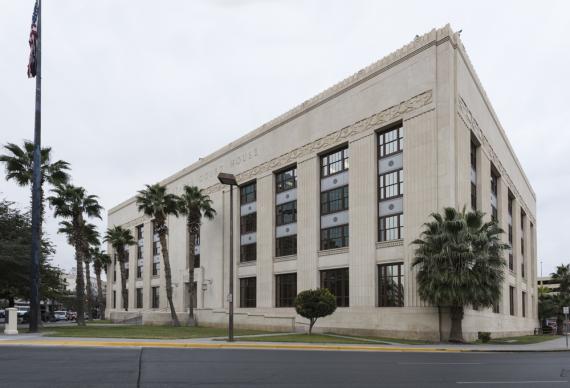
The five-story U.S. Courthouse is located on a downtown El Paso block bounded by East San Antonio Avenue, North Kansas Street, Myrtle Avenue, and North Campbell Street. In designing the limestone building, the team of architects skillfully blended Neoclassicism and the Art Deco style, a combination that was used for many federal buildings produced under the Office of the Supervising Architect of the U.S. Treasury during the 1930s.
The symmetrical building has a rectilinear plan. A fossilized limestone base extends from grade to the sills of the tall, first-floor windows. The first through fourth floor steel-frame windows are treated as continuous vertical elements, horizontally separated by cast aluminum spandrels with centered rosettes. Fluted, buff-colored limestone pilasters begin at the first story and rise to the fourth story, framing each window and entrance bay. The vertical emphasis these design elements provide is a common characteristic of Art Deco buildings.
Pink granite stairs lead to the broad, central entrance, which is flanked by smooth limestone walls, on the south facade. Doors are topped by aluminum transom grilles, and have a carved limestone surround. Original cast aluminum sconces are located on each side of the entrance, and a matching lantern is suspended within the portal.
Above the fourth story windows, the terracotta architrave has a repeating pattern of stylized eagles with shields. United States Court House is carved into the broad frieze on the windowless fifth story. The walls are capped by a simple molded cornice, stylized coping, and flat roof.
The secondary elevations continue the patterns and design elements of the facade, though they lack the wide central entrance. The raised service entry on the north end of the west elevation is surmounted by a limestone spandrel with a bas-relief swag ornament, and a panel above it is incised United States Customs.
The main, south lobby on the south side is joined to the smaller north lobby by a wide, well-proportioned corridor with a vaulted ceiling. The floor is patterned terrazzo with a Westfield Green marble border. St. Genevieve Golden Vein marble wainscot runs throughout the space and terminates into matching stone surrounds at the cased openings. Cornices, originally stenciled with ornament, crown the plaster walls. Original light fixtures hang from plaster medallions in the coffered ceiling. The mural by artist Tom Lea is on the north wall. Other original features include an original mail chute on the west wall.
The main courtroom on the fourth floor is centrally located. This two-story space restates the design of the building’s exterior with tall windows repeated between regular piers. Above the four-foot-high wood wainscoting, shaped acoustical panels give the impression of cut stones forming beams and fluted pilasters. The pilasters have plaster capitals with leaf motifs. At the three center bays, tall stained glass windows with a tartan grid open to light courts. A plaster head panel with an Egyptian figure caps each window. The courtroom’s leather-clad doors retain original hardware that was designed by the architect. Original suspended light fixtures hang from the stenciled ceiling. The judge’s bench, jury box, and witness benches have reeding designs, reflecting the building’s interior and exterior pilasters.
Significant Events
1932–1924: Site purchased and building designed
1935–1936: Building constructed
1938: Mural completed
1960s: Courtrooms added
2001: Building listed in National Register of Historic Places
Building Facts
Location: 511 East San Antonio Avenue
Architects: Percy W. McGhee, Guy L. Frazer, and Thomas P. Lippencott
Construction Dates: 1935–1936
Landmark Status: Listed in the National Register of Historic Places
Architectural Style: Neoclassical and Art Deco
Primary Materials: Limestone Prominent Features: Classical facade with stylized designs New Deal lobby mural


 U.S. General Services Administration