An official website of the United States government
Here’s how you know
Official websites use .gov
A .gov website belongs to an official government organization in the United States.
Secure .gov websites use HTTPS
A lock
()
or https:// means you’ve safely connected to the .gov website. Share sensitive information only on official, secure websites.
Expand all accordions so you may use CTRL+F to search for a particular term or text string.
Water resource management is a growing concern in the U.S. as communities face challenges regarding water supply and competition for water resources, as well as a need to update aging water treatment and delivery systems.1 Strains on water supplies and aging water treatment systems can lead to a variety of consequences for communities, such as:
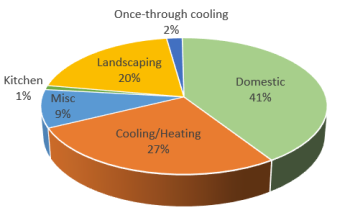
A typical federal office building with 200 employees uses about 3,000 gallons of potable water in one day. The daily water usage breaks down into the categories shown in the pie chart above.
Higher cost of water to ensure continued access to a reliable and safe supply
Expensive water treatment projects to transport and store freshwater when local demand overcomes available capacity
Increased summer watering restrictions to manage shortages
Seasonal loss of recreational areas like lakes and rivers when the human demand for water conflicts with environmental needs
The federal government spends an estimated $1 billion on water and sewer services annually.2 This includes 148 to 165 billion gallons of potable water, enough to supply a state the size of New Jersey, or 8 million people.3 Of this amount, a significant percentage can be preserved through water conservation measures4 targeting:
Distribution system improvements including leak detection, repair, and replacement
Heating and cooling including steam boilers, cooling towers, and single pass cooling
Landscaping and irrigation
Laboratory and medical equipment including water purification, sterilization equipment, and washing applications
Moderate efficiency efforts and proper maintenance of water system components can save the federal government approximately 40% of its water and related energy use, leading to beneficial resource, human, and financial implications.
Net zero concept
Efforts to further reduce water use and protect water resources can be described by the net zero concept. Net zero water refers to the concept of balancing water demand with water availability. The goal is to achieve a state where the amount of water used is equal to the amount of water replenished or restored, resulting in a net zero water balance.
Appliances such as clothes washers and dishwashers use significant quantities of water and should be selected with consideration for their impact on water and energy use. Commercial clothes washers that have earned the ENERGY STAR® are on average 9% more energy efficient and use about 45% less water than standard models. All ENERGY STAR commercial clothes washers are front load models, which do not require a full tub of water to wash and rinse clothes like a top load model and are therefore more water efficient. Commercial dishwashers that have earned the ENERGY STAR are on average 12% more energy efficient and use about 50% less water than standard models. Operating these appliances only when full will also conserve both energy and water.
Learn about acquiring energy- and water-efficient appliances, by searching FEMP’s database.
Cooling towers serve as the heat-rejection device for the building’s cooling system. Warm water carries waste heat from the chiller to the cooling tower. Through thermal interaction with the outdoor air and evaporation, the water is cooled and returned to the chiller to pick up more heat. A fan often aids in the mixing of air and water to maximize heat transfer in minimal space. As water evaporates within the cooling tower, dissolved solids become more concentrated, forming a scale that reduces system efficiency. To reduce scale buildup, water is rejected from the system in a process called “blow down” and freshwater, known as “make-up,” is added. The ratio of impurities5 in the blow down to make-up water is known as “cycles of concentration”. The higher the cycles of concentration, the less make-up is required. The following measures can be taken to properly manage cooling tower water and increase efficiency:
Eliminate single-pass cooling using potable water where feasible to maximize water savings.
Calculate cycles of concentration, which indicates the overall system efficiency. The higher the cycles of concentration, the less make-up is required.
Install water flow meters on the make-up and/or blow down lines to monitor water use.
Install conductivity monitoring equipment to automatically control the amount of blow down based on a pre-set conductivity threshold.
Consider chemical treatment that controls scale buildup, which will in turn increase cycles of concentration.
Automate chemicals based on real-time parameters such as corrosion and scale to closely match the amount of chemicals added to the cooling tower and to maximize cycles of concentration.
Consider a continuous monitoring and partial water softening system to increase the blow down setpoint.
Consider alternative water treatment technologies in place of standard chemical treatments, which have the potential to reduce make-up water and sewer costs, decrease chemical use, and increase chiller efficiency.
Install side stream filtration that filters out sediments and contaminants from the recirculating water to enable higher cycles of concentration and reduce chemical use.
Consider using alternative water sources for cooling tower make-up, such as condensate from air handling units.
The HVAC system conditions outside air to the proper temperature and humidity by exposing the air to heating or cooling elements and adding or removing moisture before distributing throughout the building. Adding moisture to the air in dry climates or during dry conditions is just as important as removing moisture from the air in humid climates or during humid conditions. But the introduction or intrusion of moisture into the building must be carefully controlled. In addition to the HVAC system, moisture can be introduced via water leaks within building systems, infiltration of the building envelope, and cleaning and other maintenance activities. To avoid moisture that can cause mold growth and other issues:
Design the building envelope to impede water intrusion and water vapor diffusion
Calibrate and operate the HVAC system to control humidity properly
Install a system to detect leaks
Control and remove water during cleaning processes sufficiently
System relationships
IEQ
Conductivity meters typically reduce the need for unnecessary blow-down cycles, ultimately saving water. These meters also help ensure that bacterial growth is kept in check, avoiding unhealthy conditions for building occupants.
HVAC
Ensure that humidity is carefully monitored and controlled through commissioning and proper operation and maintenance of the HVAC system.
Piping can carry chilled water, hot water for heating, steam, domestic drinking water, water for fire protection, and wastewater. Well-designed and maintained piping systems can help reduce pump size, save energy, and minimize water loss. Optimize the piping network through:
Ensuring proper sizing — specifying a larger pipe may add somewhat to first costs but may reduce the energy required from pumps due to lower friction7
Minimizing the number of joints, bends and turns to reduce the energy required from pumps
Detecting and repairing water and steam leaks
Providing proper insulation on steam, hot water and chilled water lines to avoid undesirable heat transfer
System relationships
HVAC
Properly insulated piping systems minimize heat loss. Where HVAC and domestic systems share equipment, pipe insulation reduces supplemental heating and cooling loads.
IEQ
Properly sized piping is likely to produce less noise, which can be distracting in office areas, and reduce the cost of sound insulation.
Older piping systems may contain lead that can contaminate drinking water. Test your building’s water supply to see if a filtration system is needed.
Leaks in piping and fittings can lead to mold or algae growth in walls, floors, and ceilings.
Solar water heating systems use the sun’s thermal energy to heat water. They consist of a collector or storage tank and a circulation system. Direct systems circulate water through solar collectors where it is heated by the sun and then used directly or stored in a tank. Closed-loop, or indirect, systems circulate a non-freezing fluid to solar collectors where it is heated by the sun then passed through a heat exchanger in the storage tank, transferring the heat to the water, then cycled back to the collectors.
Water reuse and recycling involves capturing water from on-site sources other than fresh surface and groundwater. This alternative water is typically minimally treated and used in non-potable applications such as landscape irrigation, cooling tower makeup, and plumbing fixture flushing. As a result, successfully implementing on-site water reuse and recycling can significantly reduce potable water consumption. Examples of alternative water sources include:
Rainwater – Water stemming from rainstorms but not subjected to ground contaminants. The source is typically collected from the roof and can be subjected to minor purification by percolating through the layers of a green roof.
Greywater – Wastewater from showers and sinks that typically does not include solid particulates. Blackwater, or sewage from toilet and urinal processes, is not an acceptable alternative water source without significant on-site treatment. Greywater is regulated on a state-by-state basis. Work with local water jurisdiction officials to get approval for greywater projects.
Air handling unit condensate – Water droplets accumulated through condensation on cooling coils in air handling units can be collected and reused; often cooling tower makeup is a good application for this alternative water source because of its high quality and often close proximity to the building’s cooling tower.
Process equipment discharge water – Discharge water from processes such as vehicle washing, laboratory uses, laundry and food processing that can be used in a subsequent process cycle.
Stormwater – Water collected from the building’s stormwater drainage system can be collected and treated; the level of treatment required depends on the amount of pollutants and debris that the stormwater is exposed to and the intended application.
Reclaimed wastewater - Wastewater from toilets and urinals, also referred to as blackwater, that is treated at a wastewater treatment facility and then reused in applications such as irrigation and industrial processes.
Drainage or sump water – Water collected at the foundation of the building and pumped away to avoid flooding can be collected and reused; since sump water typically has minimal contamination, minimal treatment is often required.
For more information, see the lessons learned and recommendations [PDF - 414 KB] from our National Capital Region case study. The study assessed existing water harvesting systems to identify challenges and optimization opportunities for the region’s facility portfolio and made recommendations that could inform the design, installation and maintenance of future systems anyone in the federal government and beyond might be considering. Systems evaluated included the capture of rainwater, sump pumped groundwater and grey water from sinks.
System relationships
HVAC
Green roofs not only reduce water runoff and provide a source for water harvesting, but also substantially reduce heat loss through the roof.
Consider harvesting condensate from HVAC equipment for use in water fixtures or irrigation.
IEQ
Greywater harvesting systems must be compliant with state and local building codes due to human health implications.
Kitchen
Water coolers and fountains, bottle filling stations, and water dispensers, offer convenience in delivering drinking water to building occupants. These devices typically have their own compressor and refrigerant system to cool water. Programmable controls should enable refrigeration to be powered off when not needed. Water that is delivered in large water cooler bottles or single-serving bottles should be discouraged, as it increases waste and transportation-related fuel use.
System relationships
IEQ
Access to drinking water is essential in providing a quality office environment.
Promote water use from the tap or filtered water from water coolers and dispensers as opposed to purchased water bottles to limit plastic waste streams.
Refillable water stations visibly promote hydration
Kitchens and food service processes use significant quantities of water. Much of this water is heated, which is a factor in making food service one of the most energy-intensive uses in commercial buildings. Equipment and appliances used for kitchen processes, such as pre-rinse spray valves, dishwashing, ice making, steam-based heating, and garbage disposals, should be selected or modified with consideration for their impact on water and energy use.
Pre-rinse spray valves — Energy conservation standards for commercial pre-rinse spray valves prescribe a maximum flow rate for each of three product classes, the highest being 1.28 gallons per minute for product class 3, which has a spray force of more than 8.0 ounce-force. Consider whether a lower spray force, and thus a lower maximum flow rate, is appropriate for your application.
Dishwashers — Install only ENERGY STAR qualified dishwashers and operate only when at full capacity, which not only reduces overall water consumption but also the associated energy needed to operate the device and heat the water.
Refrigerators — Models with an ice maker and/or drinking water feature may eliminate the need for an ice machine or water cooler.
Ice machines — Install only ENERGY STAR qualified air-cooled ice machines, which use less water than water-cooled ice machines, but may require more energy; existing once-through water-cooled ice machines should be retrofitted to connect to a cooling tower to recirculate the cooled water in a closed loop system. New water-cooled ice machines are covered by FEMP-designated efficiency requirements.
Steam cookers — Ensure tight fits between food trays and heating trays to reduce steam loss; fill compartments to capacity and only use as many as needed; when installing new equipment, install ENERGY STAR qualified connectionless steam cookers that are significantly more water and energy efficient than boiler-based equipment.
Garbage disposals — Retrofit disposals with solenoid valves and automatic controls that only run water while the disposal is operating; consider replacing conventional garbage disposals that use water to convey food waste, with strainers or mesh screens to collect food waste that can be used for compost.
System relationships
HVAC
Reducing steam leaks in commercial kitchens can reduce the amount of energy needed to dehumidify the space for kitchen workers and cafeteria guests.
Restroom
Domestic water heating systems heat water for building occupant use, such as in showers and sinks. Water-efficient fixtures help reduce the amount of energy needed to heat this water. Leaks in the domestic hot water system are particularly expensive, as both water and energy are lost in the process. Typical domestic water heating systems include:
Central water heating system – A central boiler and pump system distributes hot water throughout the building. These systems are good for buildings with large and relatively constant hot water needs.
Storage/tank water heater – This type of water heater has a gas or electric heat source and a tank for water storage. A constant source of energy is needed to keep the water hot, even when there is no demand.
Instantaneous/demand-type/tankless water heater – This type of water heater heats water directly as it passes through the unit without the use of a storage tank. This type of water heater must be adequately sized to provide an adequate supply of hot water without running out.
Heat pump water heater – This type of storage/tank water heater, instead of using a heating element to generate heat directly, moves heat from one place to another — for example, transferring heat from outside air to the water inside the storage tank — resulting in high energy efficiency and significant cost savings.
System relationships
HVAC
Domestic hot water generated from the building’s boiler system requires significant energy to bring it to temperature.
Consider the “water-energy nexus” in which cost savings are achieved through both the reduction of potable water purchases and wastewater treatment costs as well as the energy costs to transport, treat and heat the associated water.
Plumbing fixtures such as toilets, urinals, faucets, and showerheads dispense water to building occupants for personal hygiene, cooking, or similar purposes. Implementing a fixture replacement and retrofit policy and installing high-efficiency plumbing fixtures, which use less water than code-compliant, standard plumbing fixtures, significantly reduces overall water consumption. Alternatives to conventional fixtures include WaterSense labeled or label-eligible product types such as:
Toilets – WaterSense labeled flushometer-valve commercial toilets, whether single- or dual-flush, use no more than 1.28 gallons per flush. WaterSense labeled flushometer-valve toilets are also available with a flush volume of 1.1 gpf or less and 1.0 gpf or less.
Urinals – WaterSense labeled flushing urinals use no more than 0.5 gpf. WaterSense labeled flushing urinals are also available with a flush volume of 0.25 gpf or less and 0.125 gpf or less.
Faucets – Plumbing codes allow a maximum flow rate of 0.5 gallons per minute for public lavatory faucets and 0.25 gallons per cycle for metered faucets. For lavatory faucets in private use, WaterSense labeled bathroom sink faucets and accessories use no more than 1.5 gpm.
Showers – WaterSense labeled showerheads must demonstrate that they use no more than 2.0 gpm. WaterSense labeled showerheads are also available with a maximum flow rate of 1.8 gpm and 1.5 gpm.
Reducing the amount of heated water for faucet and shower applications also leads to energy savings.
For some applications, a waterless fixture may be appropriate. Waterless fixtures are a type of high-efficiency fixture and include waterless urinals and waterless toilets. Waterless urinals have no flush mechanism and instead have a gel-filled cartridge which forms a seal designed to prevent odors from escaping. There are various types of waterless toilets, including composting toilets> which use an aerobic process to break down waste by using little or no water.
System relationships
HVAC
Waste heat from HVAC systems can be used to pre-heat domestic hot water.
Capturing condensate from HVAC units can be used as a non-potable water source for flushing toilets and urinals.
IEQ
Automated sensor faucets limit the passing of germs among occupants.
Proper maintenance of toilets and urinals, including reducing leaks and odors, is needed to avoid unhealthy indoor environments.
Poorly calibrated sensors on faucets and toilets can lead to occupant frustration and wasted water.
Some non-water urinals need specialized treatments to the bowl area and require regular replacement of specific parts. Ensure that the custodial staff is properly trained in the maintenance of this water-saving technology.
Wastewater generated from homes, businesses, and industries is delivered via sanitary sewers to wastewater treatment facilities where it is processed and treated before being discharged to water bodies or land, or reused. Sewer fees are frequently more expensive than water consumption bills. Water-efficient fixtures and equipment and water reuse strategies may limit the quantity of water sent to wastewater treatment facilities. On-site treatment may allow for additional on-site uses of wastewater, such as irrigation or toilet flushing, which can be environmentally and fiscally preferable as sewage utility rates continue to rise.
Mechanical room
Boilers use electricity, natural gas, or other energy sources to heat water or create steam for heating systems throughout a building. As water evaporates within the boiler, dissolved solids become more concentrated, causing scale to build up in the system that reduces system efficiency. To reduce scale buildup, water is rejected from the system in a process called “blow down” and freshwater, known as “make-up,” is added. The ratio of impurities5 in the blow down to make-up is known as “cycles of concentration”. The higher the cycles of concentration, the less make-up is required. Consider the following measures to increase the cycles of concentration and water efficiency of boilers:
Institute a water treatment program to reduce the buildup of dissolved solids and increase cycles of concentration
Ensure that there is a well-maintained condensate return loop on steam systems that sends captured condensate via steam traps back to the boiler, which will in turn reduce energy, chemical and water use
Monitor condensate return and automatic blow down systems closely for leaks to prevent wasted water use
Install an automatic blow down and chemical feed system that rejects water based on specific water quality thresholds
If you are in need of a new boiler, choose a high efficiency option. The average existing boiler loses 24% of the energy intended for heating right out the flue, before it does any useful water heating. Modern boilers can exceed efficiencies of 90%.6 Maintenance is key to proper boiler operation.
Pumps are devices that use a motor to move a fluid from one place to another. In the context of buildings, pumps typically move water through pipes vertically or across long horizontal distances for use, such as cold water originating from a chiller that needs to get to the air handling unit in order to cool spaces in the building. Pipe size, material, and routing through the building all affect the workload for a pump. Pumps should be sized to operate at peak efficiency under conditions they will experience most often. Pumping systems can be made more efficient by using variable speed drives to use less energy during partial loads.
Grounds and landscape
Drip irrigation, also referred to as “micro-irrigation”, delivers water at low pressure directly at the root zone of the plant through flexible tubing and drip emitters. Drip irrigation is very efficient because it minimizes the amount of water lost due to evaporation or overspray, which is common with traditional spray type irrigation equipment. Design, installation, operation, and maintenance are critical to ensuring optimal performance of the drip irrigation system. Drip irrigation systems require more regular maintenance than conventional irrigation systems. This includes checking tubing and emitters for leaks or blockages; checking the pressure regulator, if applicable, to ensure the system pressure is within design limits; cleaning filters; and flushing the irrigation lines. Controls should be calibrated to determine the proper time of day typically early morning to minimize water loss due to evapotranspiration and amount of water needed based on real-time weather conditions and soil moisture.
Green infrastructure is a range of measures that use plant and/or soil systems, permeable pavement or other permeable surfaces or substrates, stormwater harvest and reuse, or landscaping to store, infiltrate, or evapotranspirate stormwater and reduce flows to sewer systems or to surface waters.8 Green infrastructure can replace “gray infrastructure” — gutters, pipes, and other engineered solutions — designed to move stormwater off building sites. By filtering and absorbing stormwater where it falls, green infrastructure can prevent pollutants from being picked up as stormwater moves offsite, replenish local watersheds, and reduce stress on water treatment systems. Common green infrastructure solutions:
Rainwater harvesting — Rainwater harvesting systems, which can range from a backyard rain barrel to a commercial building cistern, reduce stormwater by slowing runoff and collecting rainfall for later use.
Rain gardens — Rain gardens are shallow, vegetated depressions designed to capture, treat, and infiltrate stormwater runoff from roofs, streets, and sidewalks. This type of bio-retention is designed to mimic the natural ways water flows over land and is absorbed into soil.
Bioswales — Bioswales are essentially narrow rain gardens placed along curbs and sidewalks.
Permeable pavements — Permeable pavements are an alternative to traditional pavement surfaces. Made of pervious concrete, porous asphalt, permeable interlocking pavers, or plastic grid pavers, permeable pavements capture and infiltrate rainwater where it falls, reducing the need for some conventional drainage features. Permeable pavements require routine maintenance to prevent clogging.
Planted roofs — Planted roofs — also known as green roofs, vegetated roofs or eco-roofs — use vegetation, growing medium, and a waterproofing membrane, overlying a traditional roof, to enable rainfall infiltration and evapotranspiration of stored water.
The landscape surrounding the building can require significant water use, depending on the building’s location and landscape design. There are two aspects to reducing the need for outdoor water use:
Reduce the demand for on-site irrigation by designing a landscape that requires zero supplemental water, meaning no irrigation system needed, or minimal supplemental water (through considerate planning and design of the landscaping and selection of climate-appropriate plants). Consider appropriate plant selection, such as turf grass appropriate to climate conditions, and passive irrigation techniques that utilize topography to convey stormwater runoff via surface slopes to areas where the runoff can best support plant needs. See the xeriscaping section.
For areas needing supplemental water, use a water-efficient irrigation system with advanced controls that determine the proper amount of water needed by the landscape based on real-time weather conditions and soil moisture. See the drip irrigation section.
Exterior water features such as fountains should utilize alternative water sources. Landscape management should also include erosion control, sedimentation control, and reducing chemical use fertilizers, herbicides, fungicides, and pesticides to keep toxins and sediment out of the water supply.
System relationships
IEQ
On-site water treatment can be designed for visual appeal, such as a pond among attractive native plantings.
Permeable pavements are an alternative to traditional pavement surfaces. Made of pervious concrete, porous asphalt, permeable interlocking concrete pavers, or plastic grid pavers, permeable pavements capture and infiltrate rainwater where it falls, filtering pollutants and reducing the need for some conventional drainage features. Like conventional pavements, permeable pavements are installed atop a base of uniformly graded stone aggregate bedding. Stormwater passes through the permeable surface layer and can be temporarily stored by the aggregate bedding layer before infiltrating surrounding soil.
Permeable pavements can be used for local roadway, pedestrian walkway, sidewalk, driveway, parking lot and bike path applications and can support heavy vehicle weights when designed properly. Permeable pavements also perform best when routine maintenance is performed, like surface sweeping and periodic vacuuming, to prevent clogging. Permeable pavements should be avoided in areas where hazardous material handling and storage occur. Consider winter maintenance as well; less aggressive deicing alternatives should be utilized since some deicing products may be too harsh for permeable pavements and can lead to further issues when carried by infiltrating water into subsoil.
Stormwater runoff is rainfall or snowmelt that falls on paved or constructed surfaces, preventing its infiltration into soil where it can be slowed and filtered before replenishing aquifers or waterways. Instead, stormwater runoff runs rapidly into storm drains, sewer systems and drainage ditches, picking up pollutants and debris along the way. The excess runoff, particularly during high-volume or long-duration rain storms, can erode river banks, cause flooding, and overload water treatment systems, damaging water quality by sweeping urban pollutants into nearby water bodies. This is a particular concern in older cities with overburdened combined sewer systems that can overflow during extreme rain events, releasing untreated or partially treated human waste from sanitary sewers combined with stormwater straight to receiving waters.
Stormwater control measures and best management practices include both structural and non-structural solutions. Structural, or engineered, measures reduce pollutant loading and modify runoff volumes and flow. Examples include detention ponds, bioretention basins, stormwater wetlands, green roofs, and permeable pavements. Non-structural, or preventative, measures limit the generation of stormwater runoff or pollutants. Examples include open or green space, erosion and sediment control plans for construction projects, street and parking lot sweeping, and catch basin cleaning.
Xeriscaping, or native landscaping, is a type of landscaping method that makes routine irrigation unnecessary. The practice uses water-efficient choices in planting design and proactive landscape maintenance, including passive irrigation techniques that utilize topography to convey stormwater runoff via surface slopes to areas where the runoff can best support plant needs. It incorporates climate-appropriate and native plants to eliminate irrigation needs. Plant choices will vary depending on the local ecosystem and weather patterns. In some locations, xeriscaping means use of drought-tolerant plants; in others, it means the use of wetlands plants. Xeriscaping also uses soil amendments such as compost and mulch to reduce evaporation of water.
5 The impurities in the make-up and blow down water are measured by the conductivity of the water, which is the water’s ability to conduct electricity that indicates the relative level of dissolved mineral content in the water.
Traveler reimbursement is based on the location of the work activities and not the accommodations,
unless lodging is not available at the work activity, then the agency may authorize the rate where
lodging is obtained.
Unless otherwise specified, the per diem locality is defined as "all locations within, or entirely
surrounded by, the corporate limits of the key city, including independent entities located within
those boundaries."
Per diem localities with county definitions shall include"all locations within, or entirely
surrounded by, the corporate limits of the key city as well as the boundaries of the listed counties,
including independent entities located within the boundaries of the key city and the listed counties
(unless otherwise listed separately)."
When a military installation or Government - related facility(whether or not specifically named) is
located partially within more than one city or county boundary, the applicable per diem rate for the
entire installation or facility is the higher of the rates which apply to the cities and / or counties,
even though part(s) of such activities may be located outside the defined per diem locality.


 U.S. General Services Administration