An official website of the United States government
Here’s how you know
Official websites use .gov
A .gov website belongs to an official government organization in the United States.
Secure .gov websites use HTTPS
A lock
()
or https:// means you’ve safely connected to the .gov website. Share sensitive information only on official, secure websites.
Expand all accordions so you may use CTRL+F to search for a particular term or text string.
Utility meters are devices to measure and record the consumption of utilities such as electricity, water, natural gas, and steam. Main utility meters measure the total consumption for an entire building or property. Submeters are additional meters installed to measure utility consumption in more detail, whether for a specific area, system or device, and are often used in multi-tenant buildings, commercial spaces and industrial facilities to allocate utility costs accurately and fairly among different users.
By measuring more detailed consumption information for different buildings in a multi-building campus, different floors of the same building, different tenants in a multi-tenant office or facility, individual building systems, electrical circuits, or even specific devices, submeters can offer a powerful insight into a building’s resource use, which helps to identify building inefficiencies, meet performance goals, and improve occupant awareness. Data from well-designed submetering systems can guide management strategies that result in significantly reduced energy and greenhouse gas emissions in buildings and portfolios. As the saying goes, “what gets measured gets managed.”
Submetering components
Embedded device metering measures resource consumption down to a specific device or piece of equipment. Examples of pieces of equipment that can be measured are an individual chiller or boiler. Embedded device submetering captures resource consumption data for a particular piece of equipment which can be used to track large energy consumers closely, inform energy performance trends for commissioning, replacement or efficiency measures, and life cycle cost analysis.
End-use device metering measures resource consumption down to a specific device or piece of equipment, such as an individual chiller, boiler, cooling tower, pump or motor, to capture data with high resolution for detailed analysis. End-use device metering allows large energy consumers to be tracked closely, enabling the identification of energy performance trends for commissioning, replacement or efficiency measures, and life cycle cost analysis. See Pacific Northwest National Laboratory’s guidance [PDF] for metering best practices.
Panel or circuit metering is an important tool in resource management, as it allows for more granular insights into resource usage and facilitates targeted conservation measures. It is particularly useful in multi-tenant buildings, where accurate allocation of utility costs is essential.
Panel or circuit metering refers to the practice of installing individual meters within the panel or sub-distribution system. Panel or circuit meters can be placed at a single panel or individual circuit, or at multiple points within a panel system or branches of a circuit to measure resource use of multiple circuits. For electricity, it may be to monitor a specific electric load panel or group of circuits such as those serving plug loads. For natural gas, it may be to segregate individual boiler fuel consumption within a central plant. For water, it may be to segregate the cooling tower or irrigation system from the building-level metering system.
The purpose of panel or circuit metering is to provide more detailed and accurate data on resource consumption for specific areas or equipment within the building. This allows building owners, facility managers, and tenants to better understand and manage utility usage, allocate costs more accurately, identify inefficiencies, optimize operations and maintenance programs, and implement energy-saving measures. See Pacific Northwest National Laboratory’s guidance [PDF] for metering best practices.
System Level Metering measures resource consumption for a building system, such as lighting, heating and cooling. Examples of systems that might be metered so that resource consumption can be tracked more closely include lighting panels, central boiler plants, or central chiller plants. System-level metering enhances operations and maintenance personnel’s ability to analyze, benchmark and optimize energy performance at the system-level and enables more refined project measurement and verification. See Pacific Northwest National Laboratory’s guidance [PDF] for metering best practices.
Whole building metering is a comprehensive approach to utility metering in which a single meter is used to measure the total consumption of each utility for an entire building. By using meters to measure consumption and identify potential efficiency measures to reduce utility use, buildings can achieve higher resource efficiency, and reduce their environmental footprint. As a reminder, the meter itself does not save energy but can drive action based on review of the data.
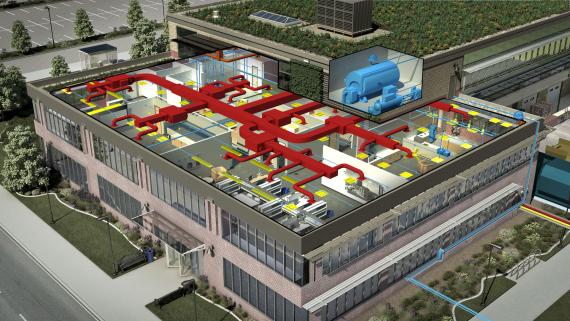
Utilities that can be measured effectively at the building level
Submeters provide the data needed for establishing a baseline and allow for benchmarking against performance standards and optimized operations and maintenance programs via fault detection and diagnostics, or FDD, and energy conservation measures, or ECMs. Choosing the right submetering placement for a building is largely determined by the anticipated benefits that help to meet performance goals. Below are the five main benefit categories that can be realized through an effective submetering program.
Economic benefits: O&M changes informed by submeter data can result in improved asset management and utilization, savings due to increased system or energy efficiency, and reduced costs. In addition, submetering systems provide more accurate billing and revenue capture.
Reliability benefits: Provide early indications of pending or actual equipment failure, allowing for proactive O&M measures that can decrease power interruptions and malfunctions and improve power quality.
Environmental benefits: Lessen the impact on the internal and external environment and reduce the impact on tenant or occupant health.
Security benefits: Enhance the security of data and physical property and reduce the risk of physical hazards to personnel.
Behavioral benefits: Heighten occupant energy consumption awareness.
Many of the uses and benefits of submetering data can also be combined to achieve maximized outcomes and savings.
Installation
What can be submetered?
In a building, various utilities and systems can be submetered to measure individual consumption and usage. Submetering data provides additional granularity on resource usage, which can help with energy efficiency, cost allocation, identifying areas for improvement and reporting goal attainment.
Electricity
Electricity usage for individual floors, units, or specific equipment like HVAC systems, lighting, or appliances.
Water
Water usage for individual floors, units or building systems.
Natural gas
Natural gas usage in commercial kitchens, water heaters, or other gas-consuming equipment.
Heat
Energy consumption from heating systems.
Cooling
Energy consumption from cooling systems, such as air conditioning units.
Chilled water
Chilled water usage in large buildings with central cooling systems.
Steam
Steam usage in industrial facilities or large commercial buildings that use steam for heating or industrial processes.
Lighting
Energy consumption from lighting systems.
Tenant space
Utility consumption from individual tenant spaces or rental units.
Equipment
Energy consumption from specific equipment, such as pumps, fans, elevators, or industrial machinery.
Metering best practices
Metering best practices involve the effective and efficient use of meters to measure and monitor various utilities and resources within buildings, facilities, or processes. These practices aim to ensure accurate data collection, promote energy efficiency, and optimize resource management. Here are some metering best practices:
Comprehensive metering plan: Develop a comprehensive metering plan that identifies the key utilities and resources to be measured. Consider installing meters for electricity, water, gas, thermal energy, and any other relevant resources to gain a complete understanding of resource usage.
Select appropriate meters: Choose meters that are suitable for the specific application and utility being measured. Consider factors such as accuracy, measurement range, and compatibility with existing monitoring systems.
Regular calibration: Regularly calibrate meters to ensure accurate measurements. Calibrations should be performed according to manufacturers’ guidelines or industry standards.
Real-time monitoring: Implement real-time monitoring systems to capture and analyze meter data continuously. Real-time monitoring allows for prompt identification of anomalies and swift response to potential issues.
Data analysis and reporting: Analyze meter data regularly to identify trends, consumption patterns, and potential areas for improvement. Create reports and dashboards to communicate findings to stakeholders.
Submetering: Consider submetering specific areas, departments, or processes to gain granular insights into resource consumption and enable cost allocation.
Energy audits: Conduct regular energy audits to evaluate energy usage and identify energy-saving opportunities. Metering data is essential for conducting accurate energy audits.
Benchmarking: Compare metering data against industry benchmarks or historical data to assess performance and set targets for improvement.
Automation: Integrate metering systems with building management or energy management systems to automate data collection and analysis processes.
Training and awareness: Provide training to personnel responsible for metering and data management to ensure proper operation and maintenance of meters. Raise awareness among occupants and users about the importance of resource conservation.
Data security and privacy: Ensure data security and privacy measures are in place to protect metering data from unauthorized access or tampering.
Continuous improvement: Regularly review and evaluate metering practices to identify opportunities for improvement and optimize metering strategies.
Traveler reimbursement is based on the location of the work activities and not the accommodations,
unless lodging is not available at the work activity, then the agency may authorize the rate where
lodging is obtained.
Unless otherwise specified, the per diem locality is defined as "all locations within, or entirely
surrounded by, the corporate limits of the key city, including independent entities located within
those boundaries."
Per diem localities with county definitions shall include"all locations within, or entirely
surrounded by, the corporate limits of the key city as well as the boundaries of the listed counties,
including independent entities located within the boundaries of the key city and the listed counties
(unless otherwise listed separately)."
When a military installation or Government - related facility(whether or not specifically named) is
located partially within more than one city or county boundary, the applicable per diem rate for the
entire installation or facility is the higher of the rates which apply to the cities and / or counties,
even though part(s) of such activities may be located outside the defined per diem locality.


 U.S. General Services Administration