


 U.S. General Services Administration
Accessible facility design
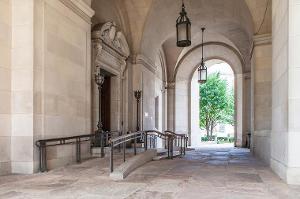
We are committed to making federal buildings and facilities fully accessible to all people. Achieving accessibility is reflected in our commitment to excellence in design, development and construction. We are dedicated to meeting or exceeding federal, state and local accessibility standards and to ensuring the full integration of individuals with disabilities who use our facilities. Because our facilities are flexible and adaptable, providing employees and visitors with disabilities the opportunity to take part in all the programs, services and activities our buildings are designed to support is an attainable goal.
Accessibility Desk Guide
Accessibility Desk Guide [PDF - 12 MB], November 24, 2015.
Accessibility in federal buildings
As the architect of projects ranging from the illuminated scaffolding of the Washington Monument to Department of Transportation headquarters, Michael Graves (1934–2015) helped define excellence for federal buildings.
After becoming paralyzed from an infection in 2003, Michael Graves became a particular advocate for disabled people in the design of public places. While physical accessibility has been a federal requirement for decades, he gained newfound sensitivity to the mobility and dignity of all building users. And thanks to him, today architects are pursuing accessibility to the fullest letter—and spirit—of mandates.
What is the Architectural Barriers Act and what standards apply?
Congress enacted the Architectural Barriers Act of 1968 requires accessibility in all federal government owned and leased buildings and facilities, and also buildings and facilities constructed, altered or leased with certain federal grants and loans.
We are one of four federal agencies Congress authorized to issue accessibility standards under the ABA. Ourcurrent implementing standard is the Architectural Barriers Act Accessibility Standard. ABAAS went into effect on May 9, 2006, for new construction and alterations, on June 30, 2006, for lease-construction facilities, and on Feb. 7, 2007, for all other leased facilities. ABAAS replaces the Uniform Federal Accessibility Standards, which was our previous standard for accessibility. Unless specifically exempted by ABAAS, all public use areas, common use areas, and employee areas must be accessible. Accessible routes must connect all accessible spaces.
Who must comply with the ABA Accessibility Standard?
Any person involved in the design, construction, alteration and leasing of federally owned or leased facilities, such as:
- Architects, engineers, and designers
- General contractors
- Realty specialists
- Building managers
- Building owners
Who enforces the ABA?
The United States Architectural and Transportation Barriers Compliance Board, or Access Board, enforces the ABA. The ABA compliance process emphasizes informal resolution. However, if informal resolution cannot be achieved, the Access Board can initiate formal proceedings before an administrative law judge to obtain an order of compliance. Penalties for non-compliance can include the withholding or suspension of federal funds with respect to the building found not to be in compliance with ABAAS.
Who do I contact for technical assistance with the requirements of the ABA Accessibility Standard?
We have a National Accessibility Officer who is responsible for the implementation of our National Accessibility Program. They can be contacted for technical information and assistance concerning the application of ABAAS to our facilities.
In addition, the U.S. Access Board provides information about the ABA by telephone, fax or email. Design professionals and others can contact the Access Board to ask questions about general or specific ABA requirements including questions about our ABA Accessibility Standard.
Contact the Access Board at:
- Phone (voice): 202-272-0080 toll free: 800-872-2253
- Email: TA@access-board.gov
What is our policy for accessible design?
It is our policy to make all federal buildings accessible without the use of special facilities for persons with disabilities. The intent of this policy is to use standard building products set at prescribed heights and with prescribed maneuvering clearances to allow employees and visitors with disabilities easy use.
In addition to ABAAS, are other accessibility standards for accessible design?
ABAAS is mandatory for all of our agency’s design and construction projects. The A/E is also responsible for compliance with all applicable state or local accessibility standards. Where such exist, the most stringent accessibility requirements are to be applied regardless of whether they are contained in state or local codes and regulations or ABAAS.
Are construction tolerances permitted in ABAAS?
Where dimensions for clearances are stated in ABAAS, allowance must be made for construction tolerances in the design to ensure that the finished construction is in full compliance with the stated dimensions.
Is ABAAS Retroactive?
Where existing, unaltered elements of a building or facility comply with an earlier ABA standard such as UFAS, they are not required to be retrofitted to comply with ABAAS. However, if these elements are altered, they must comply with ABAAS or a future implementing standard of the ABA that is applicable at the time of the alteration.
What are some of the major elements of a federal building or facility that must be on accessible routes, where planning for accessibility is critical?
Entrance doors, entrance vestibules, interior doors, corridors, toilet rooms, telephones and TTYs, drinking fountains, visible and audible alarms, signage, wheelchair seating in assembly areas and dining facilities, service counters, and ramps or elevators where changes in level are necessary.
Does ABAAS permit the use of portable ramps or lifts?
No. Portable ramps and lifts are not permitted under ABAAS, because they are not permanent components of a building.
Does ABAAS permit the use of partially built-in ramps that require assistance to deploy before use and lifts that require assistance to use?
No. ABAAS requires unassisted use of ramps and lifts.
Does ABAAS permit the use of stairway chairlifts?
No. Stairway chairlifts are not permitted under ABAAS, because they do not accommodate an occupied wheelchair.
Does ABAAS permit a parallel approach to accessible drinking fountains?
No. A parallel approach is not allowed under ABAAS, except at certain drinking fountains for children’s use where knee clearances cannot be accommodated because of the lowered height of the unit. Section 602.2 contains an exception that allows a parallel approach to units for children’s use where the spout height is 30 inches maximum above the finish floor or ground and is located 3 1/2 inches maximum from the front edge of the unit, including bumpers.
Are all repair and alteration projects required to include costs for upgrading accessibility features?
No. ABAAS defines the term “alteration” in Section F106.5. Normal maintenance, reroofing, painting or wallpapering, or changes to mechanical and electrical systems are not considered alterations unless they affect the usability of the building or facility. For example, if a wall containing doors or doorways must be demolished in order to install new plumbing and vent risers, new doors or doorways that are installed in the rebuilt wall must comply with ABAAS, including providing sufficient clear width, accessible hardware and maneuvering clearances.
ABAAS Section F202.4 requires that alterations to areas containing a primary function include accessible routes, toilet rooms, telephones, and drinking fountains to serve the altered area(s) unless the cost and scope for these accessible features are “disproportionate” to the overall alterations as we determine. Are all spaces within a building considered primary function areas?
No. We define “primary function areas” as those spaces that contain a major activity for which the facility is intended. Primary function areas include areas where services are provided to customers or the public, and offices and other work areas in which the activities of the federal agency using the facility are carried out. Ancillary spaces such as mechanical rooms, boiler rooms, supply storage rooms, employee lounges or locker rooms, janitorial closets, toilet rooms, corridors and entrances are not primary function areas.
Is there a point at which the costs of providing an accessible path of travel to an altered area containing a primary function are considered “disproportionate” to the cost of the overall alteration and therefore, additional accessible path of travel improvements are not required?
Yes for federally owned and funded properties subject to ABAAS and No for leased facilities. For facilities subject to the ABAAS, the costs of alterations to provide an accessible path of travel to an altered area containing a primary function are disproportionate to the costs of the overall alterations when they exceed 20 percent of the costs of the alterations to the primary function area. If a series of small alterations are made to areas containing a primary function and the costs of any of the alterations considered individually would not result in providing an accessible path of travel to the altered areas, the total costs of the alterations made within the three year period after the initial alteration must be considered when determining whether the costs of alterations to provide an accessible path of travel to the altered areas are disproportionate. Facilities for which new leases are entered into must comply with Section F202.6 of ABAAS without regard to whether the costs of alterations to comply with Section F202.6 are disproportionate to the costs of the overall alterations.
Are alterations to historic properties required to meet ABAAS?
Yes. Alterations to qualified historic buildings and facilities (a building or facility that is listed in or eligible for listing in the National Register of Historic Places, or designated as historic under an appropriate State or local law) are required to meet ABAAS. There are exceptions for alterations to qualified historic buildings and facilities for accessible routes, entrances and toilet facilities when the State Historic Preservation Officer or the Advisory Council on Historic Preservation determines that compliance with the requirements for the specific element would threaten or destroy the historic significance of the building or facility. These exceptions are in Sections F206.2.1, F206.2.3, F206.4 and F213.2, and contain specific requirements for alternative means to achieve access.
Are new leases negotiated by the federal government for buildings and facilities required to meet ABAAS?
Yes. All new leases are required to meet ABAAS except:
- Buildings or facilities officials servicing disasters on a temporary, emergency basis have leased for use
- Buildings or facilities leased for 12 months or less (provided that the lease may not be extended or renewed). Lease renewals, lease options, etc, must be treated as new leases.
Can an accessibility complaint corrective action be placed on hold until the next repair project is undertaken?
No. An accessibility complaint corrective action cannot be placed on hold until the next repair project is undertaken. A valid complaint must be corrected at the earliest possible date. By law, the Access Board has 180 days to resolve a complaint. A correction or corrective plan of action must be proposed within that time.
Construction drawings dimensioned in metric were arrived at by multiplying inches by 25.4, giving the metric equivalent in millimeters. Based on this calculation, it seems as if the ABAAS metric equivalents have been rounded up. Can this conversion be used instead?
No. In order to be compliant with ABAAS, the metric equivalents provided in ABAAS must be used.
Do you have other design requirements for accessibility?
Yes. On February 24, 2025, GSA rescinded GSA’s Facilities Standards for the Public Buildings Service (P100) and issued the GSA Core Building Standards. This document summarizes applicable statutorily-required facilities standards. In addition to ABAAS, applicable accessible design requirements exist in the International Building Code (IBC) chapter 11, and in local and state-adopted building code where the facility is located. While the P100 required power-assist or automatic doors at all accessible public entrances, power-operated or low-energy power-operated doors are required in the IBC section 1105 based on building occupancy. The U.S. Courts Design Guide applies to Court Facilities and contains accessibility requirements for courtroom elements.