Available contract options
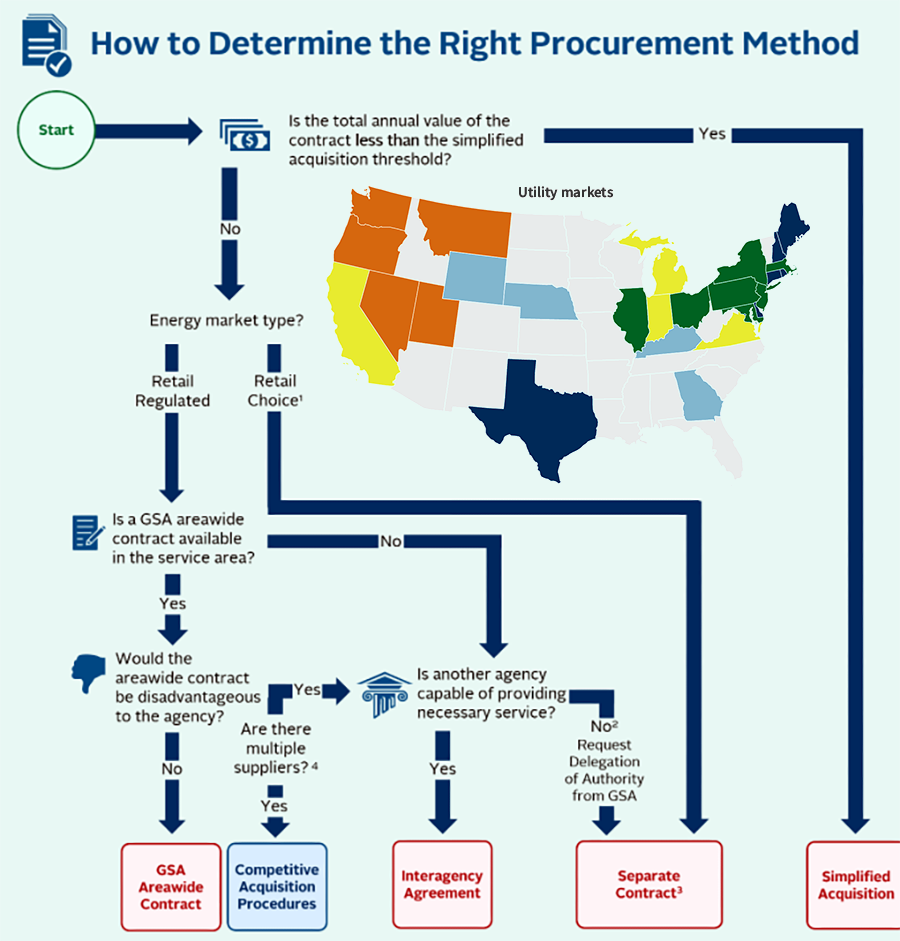
Your contract method depends on your market and needs.
Areawide contracts
The GSA Areawide contract is our agreement, or master blanket contract, with a utility provider, typically lasting up to 10 years. Once established, any federal agency within the service area can use it. These contracts provide long-term stability, financial flexibility, and a consistent process for connecting facilities to essential services.
Areawide contracts are the standard and often required method in regulated utility services markets when spending exceeds the simplified acquisition threshold, per the FAR.
How it works
- GSA establishes the contract with the utility provider
- The contract includes all required federal terms and conditions
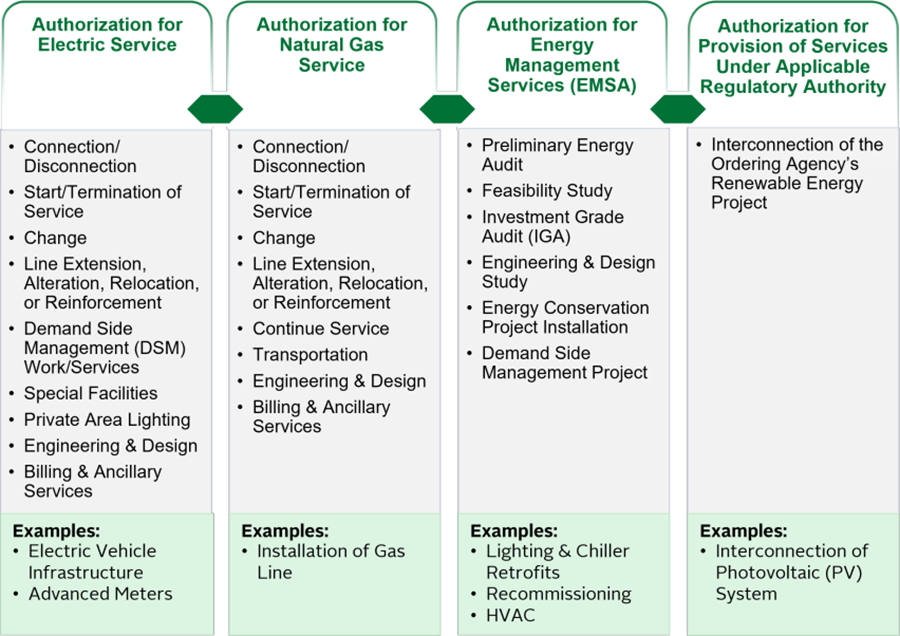
- Agencies sign an authorization to define their specific service or project
- The authorization captures agency-specific details
Why use it
- Streamlined acquisition with pre-negotiated terms
- Flexible, and supports addenda for special requirements or rates
Energy management and UESCs
Areawide contracts can also be used for Utility Energy Service Contracts, or UESCs.
- Utilities provide analysis, design, installation, and financing
- Projects are paid for over time through energy and water cost savings (“avoided cost”)
Additional guidance is available through the Department of Energy’s FEMP program.
Separate contracts
Separate contracts are also known as single-point contracts and you should only use them if one of the following is true:
- An Areawide contract is not available in the service area
- Multiple utility companies exist in the service area
- Your agency determines Areawide is not advantageous to the government
Agencies should coordinate with us before initiating a separate contract.
Interagency agreements
Agencies may acquire utility services through another federal agency under the Economy Act (FAR 17.502-2).
When to use
- When another agency can provide the service effectively
Important considerations
- GSA involvement is not required
- Agencies should evaluate GSA’s options first
- Agencies must have the expertise to manage the acquisition
Simplified acquisitions
For acquisitions at or below the simplified acquisition threshold:
- Use FAR Part 13 procedures
- A bilateral written contract is not required
- If a contract is used, it must include required clauses (FAR 41.501)
Retail choice contracts
In deregulated markets, agencies can purchase electricity and natural gas from competitive suppliers.
We manage these procurements using contract vehicles and competitive sourcing methods to obtain the lowest price from technically qualified suppliers.
How it works
- Agencies enter into a Memorandum of Agreement with GSA to participate in retail choice procurements
- We aggregate demand across agencies
- We conduct market research and issue solicitations
- We use reverse auctions for suppliers to compete on price
- We award contracts to qualified suppliers
- Agencies place task orders for services
- The contracts allow for a variance of +/- 20% more or less in usage
- We ask account holders for their past and expected usage to estimate contract needs. We calculate the total difference between estimated and actual usage across all agencies (it is rare for a single account’s variance to cause the contract to exceed this limit).
What GSA manages
- Developing and issuing solicitations
- Running reverse auctions
- Awarding and administering base contracts
To inquire about joining a retail choice contract, email utilities@gsa.gov.
Auction process
GSA uses an internet-based platform for supplier bidding.
- Suppliers submit pricing through the platform
- Competition drives lower pricing
Agencies participating in the procurement agree to pay a fee of (currently $0.0007) per kWh for all usage billed under each awarded contract. This fee is included by the supplier on the invoice and supports the platform and services.
Retail choice task orders
After contract award:
- Agencies issue task orders for supply services
- Agencies must also arrange for delivery via an Areawide contract or the local utility
- Agencies are responsible for billing, payment, and task order administration
Important considerations
- Prices are typically firm-fixed but may adjust due to regulatory or tax changes
- Contracts include FAR Parts 12, 15, 16, and 41 clauses
- Contract terms should not be modified at the task order level without GSA approval
- Usage estimates include a ±20% variance across the contract
- Regulatory changes may result in contract updates and billing adjustments
Information for vendors
Utility providers interested in establishing an Areawide contract can contact utilities@gsa.gov.


 U.S. General Services Administration