- Improve energy efficiency.
- Drive your energy use down, then drive it down further!
- Reducing your energy needs is much less expensive than providing renewable energy.
- Implement an energy management system.
- Implement the plan-do-check-act cycle to sustain energy and cost savings in a best practice strategy for connecting staff behavior and energy demand.
- Use the 50001 Ready Navigator, a step-by-step guidance to achieve continuous energy improvement.
- Learn about renewable energy.
- Identify options for emission-free energy sources, including on-site, off-site, and partnerships.
- Invest wisely.
- Consider how all procurement and investments impact the net zero energy goal.
- Prepare a basic action plan and start to implement it.
- Net zero energy is no longer just a target, it is increasingly becoming a requirement.
- Consider implications for long range planning.
Basic action plan
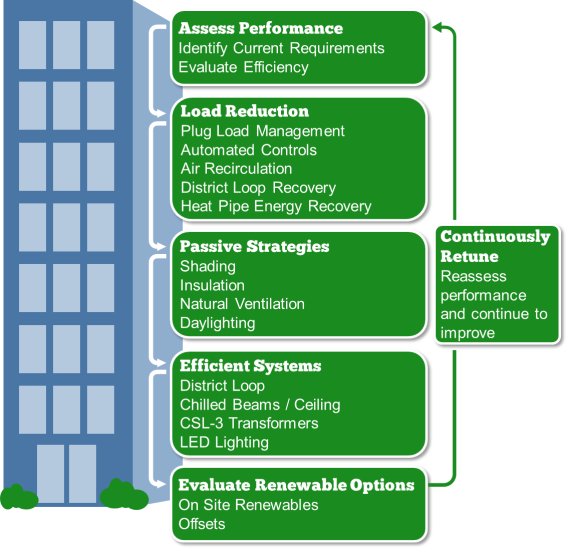
Assess your performance
Understand how your building uses energy by introducing an energy management system at your facility using DOE’s 50001 Ready Navigator.
Identify current requirements. What are the needs for building operations? For occupant activities? The more detail you can provide, the better. Describe energy needs by type, floor, activity, time of day, etc.
Evaluate your efficiency. How efficiently do you meet the needs? Not every building has separate meters for different spaces or activities, but even without specific measurements, some efficiencies will be obvious. Are lights on in unoccupied spaces? Does equipment go to “sleep” when not in use? Does the HVAC work “harder” at some times than others?
Develop an integrated team approach. Energy demand is affected by a range of building features and occupant activities; identify key team representatives for each.
Update and improve
Do the simplest, least expensive projects first. Evaluate more expensive projects, as well as planned purchases and renovations, in terms of net zero energy. Will the new or renovation effort reduce energy use? Will it facilitate conversion to renewable energy?
Load reduction. Develop policies and active strategies such as installing or programming automatic controls. Examples include:
Passive strategies. Passive strategies rely upon the building itself to manage occupant comfort and reduce energy needs. Examples include:
Efficient systems. As you reduce your energy requirements, your systems, e.g., HVAC, lighting, may no longer be optimally sized. They may be designed for a larger load; operating for lesser loads is usually inefficient. Stage improvements accordingly.
Energy recovery. Examples include:
Evaluate renewable options
After reducing your energy use, the balance under net zero energy buildings targets will need to be obtained from zero-emission sources.
On-site renewables. Examples include:
Off-sets. These may include a variety of source energies developed through a collective approach. Examples include:
- Renewable energy certificates, or RECs
- Energy districts and partnerships
Continuously retune
Reassess your performance and continue to improve.
- Reassess throughout this basic action plan.
- Optimize your operations to make the most of what you have.
- Meet regularly with your integrated team and keep talking about performance improvement.
- Consider producing more energy than your building uses, helping others reach net zero energy.
Implications for long range planning
For net zero energy buildings, energy requirements must be obtained from zero-emission sources. That means you will need renewable energy generation — either on-site or off-site. So facility cost-benefit comparisons should consider the eventual expense and potential savings of renewable energy acquisition.
Facility repairs and renovations
Repair may solve an immediate problem, but upgrade or replacement may prove to be the better investment overall. Determining which upgrade or replacement is optimum may be different when evaluating options for a net zero energy building. One solution may be more compatible with – or convertible to – a particular renewable energy system.
Portfolio management
Incorporate net zero energy building targets into contracts. Consider Energy Savings Performance Contracts or ESPCs. Assess a building’s potential for renewable energy generation in property valuation. Identify and compare inherently efficient building characteristics, opportunities for on-site generation, and availability of renewable energy for purchase or trade.
Partnerships
Not all buildings will be able to generate the energy they need on their own sites. Many will need to explore some sort of creative partnering, for example, districts or associations. Perhaps one partner has sufficient roof area for significant solar energy generation, and other partners invest in the installation of the photovoltaics.


 U.S. General Services Administration