The U.S. General Services Administration’s (GSA) mission is to deliver the best stakeholder experience and value in real estate, acquisition, and technology services to the federal government and the American people. GSA is committed to providing safe, healthy, and productive workplaces for federal workers at the best value for the American taxpayer.
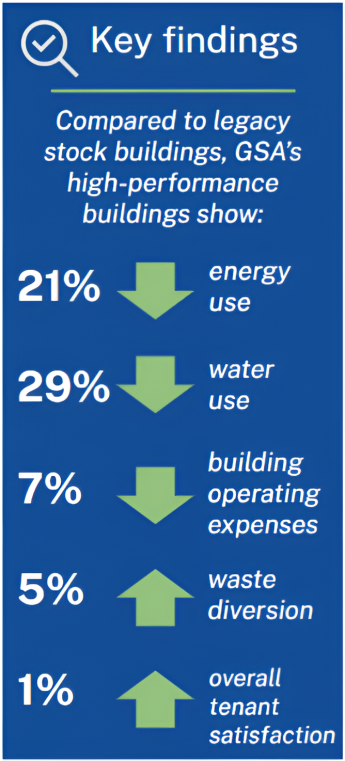
GSA’s high-performance buildings are an essential element supporting this commitment. High-performance buildings cost less to operate, use less energy and water, divert more waste from landfills, and have more satisfied occupants compared with legacy stock buildings. In short, they deliver efficiency, effectiveness, and cost savings for American taxpayers.
This data-driven study examined more than 600 buildings over two years and 27,000 data points. The study replicates and expands on a similar study of 200 GSA buildings that was published in 2018 [PDF - 3 MB]. The updated results confirm that GSA’s high-performance buildings continue to deliver greater savings and higher efficiency than their legacy-stock counterparts, while outperforming industry benchmarks.
GSA’s high-performance buildings cost less to operate, use less energy and water, produce less waste, and have more satisfied occupants compared with typical buildings.
The study demonstrates the value in savings and efficiency of high-performance federal buildings. GSA is the largest owner and operator of office space in the country, managing a nationwide real estate portfolio of over 360 million rentable square feet of buildings including offices, courthouses, and land ports of entry. Within GSA’s fiscal year (FY) 2024 portfolio, 39% of our owned buildings, and 51% of our owned gross square footage, qualified as high-performance. Throughout their life cycle, these buildings have lower operating costs and higher efficiency, delivering value for American taxpayers.
GSA will use this study to continue to deliver efficiency and cost savings, promote effective American high performance building technologies, and demonstrate excellence in federal building stewardship. This study’s industry-leading data, analysis, and findings can help non-GSA building portfolio owners and managers understand the benefits of delivering, tracking, and learning from performance results.


 U.S. General Services Administration